Why Incrementality Testing Belongs with Your MMM and Where to Start
MMM alone can't beat multicollinearity and noise. See why incrementality testing should anchor your model, with real results from StockX and OluKai.
Aug 4, 2026

Marketing Mix Modeling (MMM) exists to guide one core decision: where each marketing dollar should go to make the most impact. Enterprise teams lean on MMM because it promises a cross-channel view of how spend tradeoffs translate into outcomes. But that promise comes with a catch. MMM is built to guide budget allocation toward the highest incremental return, but the data the recommendations are built on is from historical spend data that’s often messy and hard to trust on its own.
Two problems with this approach show up again and again. The first is multicollinearity: When major channels scale up and down together, or when budget decisions move in lockstep with overall business growth, the model has a hard time telling which channel actually caused the result. The second is noise — seasonality, supply constraints, consumer spending trends, and plain randomness all distort the signal a model is trying to read. Even a well-built MMM is vulnerable to both.
That's why Haus’ MMM methodology requires experiments. MMM results inform budget decisions, and experiments validate those recommendations through causal ground truth.
Why MMMs need causal data as ground truth
Let’s separate the three tools marketers reach for. Attribution assigns credit to touchpoints along a digital-only conversion path — it shows you where a conversion appears to have originated, but not whether that touchpoint actually caused it, which makes it correlational. MMM takes a broader lens, examining the relationship between channel spend and outcomes over time, making it useful for cross-channel planning and budgeting. But like attribution, it's fundamentally correlational. Two MMMs can provide the same sales forecast while disagreeing about which channels are driving it, because prediction and proof aren't the same thing.
Incrementality testing is built to answer whether a marketing tactic actually caused an outcome or whether it would have happened anyway. By splitting audiences into treatment and holdout groups, an experiment isolates the true effect of a campaign. If sales rise more in the treatment group than the holdout, that difference is incremental lift. It’s not a modeled estimate of lift, but a measured one.
The trade-off is that experiments are a snapshot: one campaign, one timeframe, one channel, one test at a time. That's why incrementality tests work best as filters and priors for your MMM, not instead of an MMM.
That said, not all experiment-to-MMM connections work equally well. The most accurate and actionable approach is an MMM that incorporates incrementality results as the model runs, before it generates outcomes, not after. Even better is an MMM that accounts for when an experiment was run and weighs it appropriately based on the business's seasonality.
For a deeper look at how these tests are structured, see the full mechanics of incrementality testing.
Not all priors are created equal
Every Bayesian MMM needs priors — a starting view of how each channel's spend relates to the outcome. Those can come from academic studies, benchmarks, industry knowledge, or past MMM and attribution results. However, these types of inputs can be generic. They don’t recognize the nuances of your individual business. Leaning on prior MMMs or attribution equips your model with correlation-based signal instead of causal signal. The harder input to get to – but critical to combat multicollinearity and results you trust – is understanding where a prior comes from and weighting it appropriately.
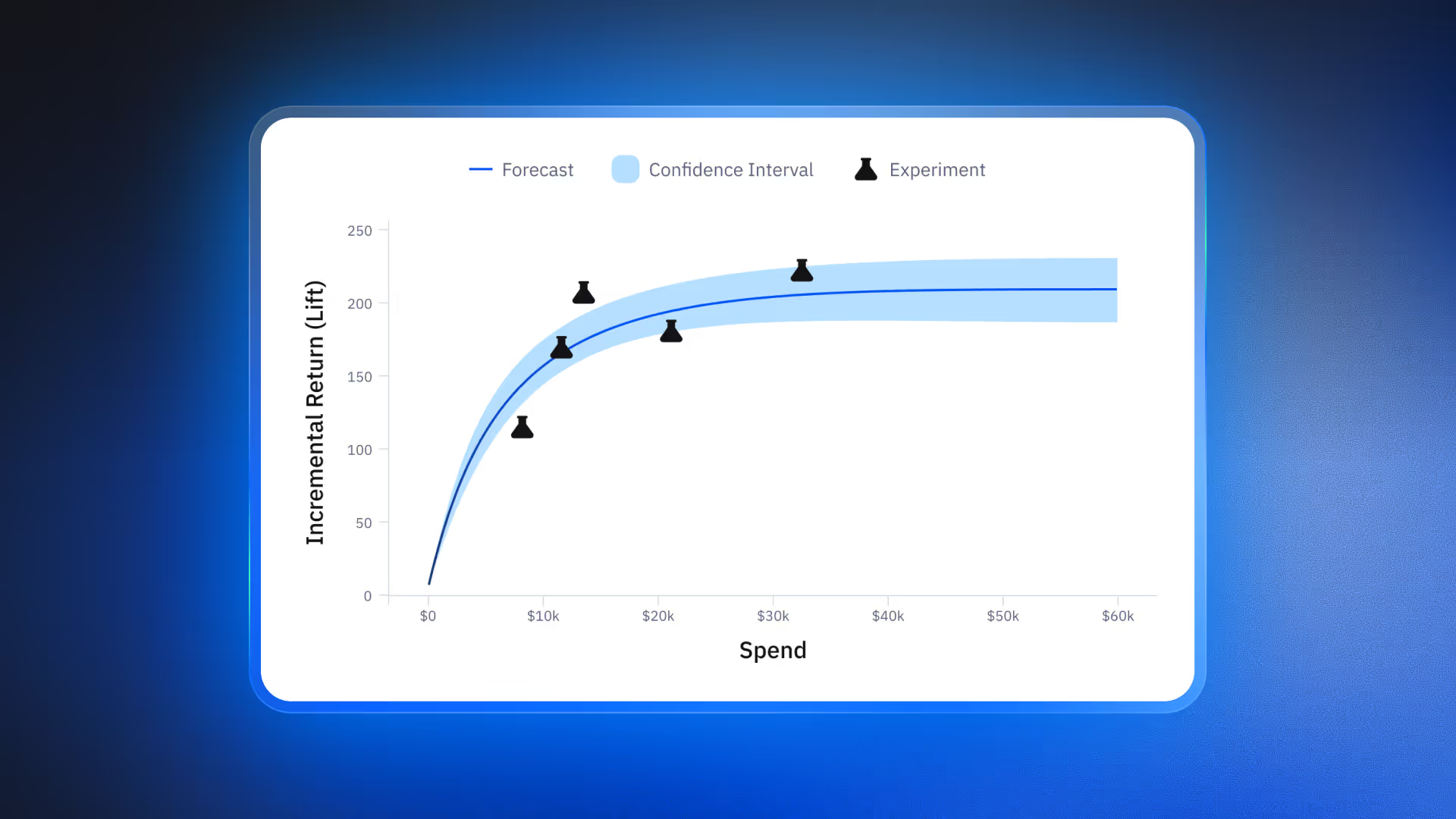
Haus’ Causal MMM approach puts incrementality first. When a channel has a Haus experiment, we treat that result as ground truth. The experiment doesn't merely "calibrate" the model; it anchors the response curve. The trust you put into a well-designed test is now a core input in your Causal MMM that carries more weight than a prior that isn’t directly informed by your business data. For channels without a test, we use incrementality signals as informed starting points — trusted third-party studies, or Haus incrementality priors tailored to your brand's own experiment results — that anchor the curve until direct evidence arrives.
This helps most exactly where MMM struggles: channels that move together, or history too thin to carry the model alone. The alternative is stacking on more assumptions, and every assumption adds a layer of judgment that separates results from data. The more defensible path is to give the model better data in the first place, and experiments are the highest-quality data available to feed it.
How to use experiments to inform your MMM
Bringing experiments into your MMM effectively means being deliberate about which experiments you use and how you weigh them.
Start with test design. Incrementality tests give you the anchor for the return curve because the results of these tests provide the incremental result and the baseline. Without having the baseline as an anchor, a slope can still be drawn between two spend levels, but you don’t know where that curve should actually start. The granularity of tests and how they map to channel usage is key to how actionable an experiment can be within your MMM. If your MMM splits Meta into ASC, prospecting, and retargeting, but your test measures Meta all-up, the lift you capture won't map cleanly back into the model. The same mismatch shows up when a Google test spans Search, PMax, and YouTube together instead of isolating one, or when a test measures a tactic like bid strategy that your MMM doesn't track at that resolution.
From there, determine your priors and how they should be used. Incrementality tests are grounded in your own business data. That should matter more than generic priors that apply to an entire industry or aren’t grounded in incrementality. Haus’ Causal MMM recognizes the difference between these two things and weights them appropriately.
But none of this works if the MMM itself wasn't built to accept experiments in the first place. Feeding in an experiment result disrupts a carefully curated set of priors and weights, a bonsai-like structure the vendor has spent a long time shaping. If experiments weren’t part of the build, it can fight the model instead of strengthening it. So the real question isn't whether an MMM can accept priors in theory. It's whether the MMM you've chosen was ever built for that purpose. If it wasn't, everything above is moot.
Finally, tests age. Platforms change targeting options, execution shifts across bidding, creative, and audience strategy, account structures get restructured, and eventually a test falls outside your MMM's training window entirely. No fixed cadence works for every brand, but the more often you re-run channel-level experiments, and the more the MMM you use is built to seasonally adjust results to make sure experiments stay up to date, the more trustworthy your data is.
What this looks like in practice
The value of pairing experiments with MMM isn't theoretical. StockX's finance and marketing teams had spent years managing their largest expense on static budgets and gut feel, with limited visibility into channels like YouTube beyond last-click conversions. Once incrementality testing gave them a causal read on YouTube's performance, that result became an input into their Causal MMM. The model, grounded in that test, went on to surface a scaling opportunity in a channel that a correlation-only model had left buried as a "nice to have."
OluKai saw the reverse scenario just as clearly. A legacy MMM built on historical correlation kept recommending more spend on view-through-heavy channels, while their incrementality results told a different story. When the two disagreed, the team trusted the experiment and reallocated spend toward the channels the tests actually validated as incremental, cutting customer acquisition cost (CAC) by 20% almost overnight.
In both cases, the lesson is the same: An MMM without experiments is a forecast built on correlation that’s vulnerable to noise and multicollinearity, no matter how sophisticated the modeling gets. Pairing the two doesn't just make the model more accurate. For StockX, it served as a unifying mechanism between finance and marketing, building a transparent, cross-functional capital-allocation process both teams trusted.
Neither team found success by picking one method and discarding the other. As OluKai's VP of Ecommerce put it, when clear experimentation and directional measurement disagree, incrementality should win. Combining GeoLift with causal MMM modeling is what let them see what was truly driving growth. Other brands working through the same tradeoffs tend to land on the same conclusion: A model is only as trustworthy as the data behind it, and the highest-quality data a marketing team can generate is based in causal proof.
FAQs about incrementality testing and MMM
Why can't MMM stand on its own?
MMM estimates channel effects from historical spend and performance data, which means it's vulnerable to multicollinearity and noise, especially when channels move together or when the market gets volatile. Without experiments to anchor it, different models can hit the same forecast while disagreeing on which channels matter — prediction isn't the same as proof.
What does it mean to calibrate an MMM with experiments?
Calibration means feeding the results of well-designed incrementality tests into your MMM as priors, so the model has a causal starting point instead of an assumption. This reduces overfitting and keeps the model's estimates grounded in what actually happened, not just what correlates.
How often should you re-run incrementality tests?
There's no universal cadence, but tests age as platforms, execution, and account structures change, so the more up-to-date your tests are, the more trustworthy your calibration stays.
What happens when your MMM and your incrementality tests disagree?
Trust the experiment. As OluKai put it, when clear experimentation and directional measurement results disagree, incrementality should win — and both OluKai and StockX saw better outcomes by following their test results over an uncalibrated model's recommendation.
.png)
.png)


.png)
.png)

.png)

.avif)


.avif)
.avif)

.avif)

.avif)

.avif)
.avif)
.avif)


.avif)


.avif)


.avif)
.avif)
.avif)
.avif)
.png)
.png)
.avif)


.avif)
.avif)
.avif)
.avif)
.avif)
.avif)

.avif)

.avif)

.avif)

.avif)
.avif)
.avif)
.avif)
.avif)


.avif)
.avif)

.avif)
.avif)

.avif)
.avif)
.avif)

.avif)

.avif)
.avif)
.avif)
.avif)

.avif)


.avif)
.avif)



.avif)
.avif)
.avif)

.avif)
.avif)
.avif)
.avif)
.avif)
.avif)




.png)
.avif)
.png)
.avif)