MTA vs. MMM: Choosing Between Multi-Touch Attribution and Marketing Mix Modeling
Let's unpack the differences between multi-touch attribution (MTA) and marketing mix modeling (MMM) and when each approach comes in handy for marketers.
Dec 26, 2025

The path to purchase is rarely a straight line. A customer might see your brand in an Instagram ad, hear about it again on a podcast, then see a CTV ad that seals the deal and spurs a purchase. Any modern marketing team wants to understand this customer journey in detail — and in many cases, they’ll turn to multi-touch attribution (MTA) to piece together that story.
But what if MTA doesn’t tell the whole story? What if you want an aggregate view of your different channels and how they contribute in the context of your entire marketing mix? In that case, you might want to add marketing mix modeling (MMM) to your measurement stack.
If we were to come up with an analogy for MTA vs. MMM (and yes, we enjoy analogies here at Haus), you might say MTA is the microscope that provides granular insight into campaign performance. Meanwhile, MMM is the telescope that helps you understand how your whole constellation of marketing activities work together.
Both are valuable, but they also have limitations. We’ll outline them all below and help you figure out if MTA, MMM, or some combination of both is best for your business.
What is multi-touch attribution?
Marketing attribution is a measurement approach that tells you how different marketing touchpoints contribute to a conversion. Often, multiple touchpoints influence a conversion. For instance, you might hear an influencer mention a product, then see an Instagram ad for that same product, then see a linear TV ad.
Multi-touch attribution assigns credit to each of these touchpoints along the way. A third of the credit goes to the influencer ad, another third to the Instagram ad, and the final third to the linear TV ad.
This differs from a first-click attribution model, which assigns credit to only the first touchpoint. Last-click attribution assigns credit to the final touchpoint before purchase. Multi-touch attribution shares the wealth, attempting to reflect the full user journey.
Are there downsides to multi-touch attribution?
Yes, attribution has limitations. First of all, platform-reported attribution numbers are often skewed. Platforms are “grading their own homework” and often overcrediting their impact. Attribution models are also built on correlational data rather than causal data, which means you can’t know if these marketing touchpoints are causing conversions or if these conversions would have happened anyway.
MTA relies on user-level data. Given the impact of privacy regulations, this reliance on click-level visibility makes it increasingly difficult to measure these touchpoints. Multi-touch attribution is strongest in environments with ample user-level data available, because accurate user identity enables complete journey reconstruction, which is essential for fair and reliable credit assignment across touchpoints.
How do marketing teams use multi-touch attribution?
Multi-touch attribution can be a helpful way to identify influential touchpoints and pathways to purchase. For instance, MTA might help you determine that Meta ads are a major touchpoint for your customers. You might decide to double down on Meta as a result. The reverse is also true. You might find certain channels are rarely contributing to purchases, so you pull back spend on those investments.
In short, attribution gives marketing teams the insights they need to guide strategy. It gives you actionable information on what is and isn’t working in your funnel. Additionally, an attribution model can help marketers demonstrate to leadership that specific tactics are effective in driving conversions.
How does multi-touch attribution work?
There are four key steps to MTA: collecting the data, stitching it together, distributing credit, and then aggregating insights. Let’s break each down in a bit more detail:
Step 1: Collect user-level event data
Multi-touch attribution starts by collecting granular, user-level event data such as ad impressions, clicks, pageviews, and conversions. Each event must be precisely timestamped so interactions can be ordered and analyzed across the customer journey. In practice, this requires integrating data from multiple platforms — ad networks, analytics tools, and CRM systems — which introduces complexity and potential data gaps from the start.
Step 2: Stitch together user journeys
Once events are collected, MTA attempts to stitch them into individual user journeys using identifiers like cookies, device IDs, IP addresses, or login credentials. This process breaks down when identifiers are missing, inconsistent, or reset — an increasingly common issue in a privacy-constrained environment. As a result, cross-device and cross-channel journeys are often incomplete, leading to fragmented views of how customers actually convert.
Step 3: Apply an attribution model to distribute credit
With user journeys assembled, an attribution model is applied to assign conversion credit across touchpoints. This can be rule-based (e.g., last-click, linear) or algorithmic, but all approaches rely on assumptions about how influence should be weighted. The resulting insights are highly sensitive to model choice, meaning different attribution frameworks can produce materially different conclusions from the same underlying data.
Step 4: Aggregate insights to evaluate campaigns/channels
Finally, MTA aggregates user-level results to produce channel- and campaign-level performance metrics, such as ROI or cost per conversion. These insights are commonly used to optimize bids, budgets, and creative execution across digital channels. Because MTA updates quickly, it can be effective for short-term optimization and rapid experimentation — assuming the underlying data is reliable.
What are the different types of multi-touch attribution?
Multi-touch attribution is a broad term, and there are multiple different approaches teams can take to leverage MTA. Here are a few popular types:
- Linear attribution assigns equal credit to every touchpoint in the customer journey. It’s simple to implement, but it often dilutes the impact of the interactions that actually drive conversion.
- Time decay attribution gives more credit to touchpoints that occur closer to the conversion event. This approach reflects recency-driven decision behavior but can undervalue early-stage influence.
- U-shaped (position-based) attribution allocates most of the credit to the first and last touchpoints, with the remainder spread across the middle. It emphasizes both demand generation and conversion drivers, but simplifies the complexity of the journey in between.
- W-shaped attribution prioritizes the first touch, lead creation milestone, and final conversion. It’s commonly used in B2B funnels where mid-funnel actions represent meaningful intent.
- Algorithmic or data-driven attribution uses machine learning to infer the contribution of each touchpoint based on observed patterns. While potentially more accurate, it requires large, clean datasets and can be difficult to validate or explain to stakeholders.
What are the benefits of multi-touch attribution?
There are some clear benefits to multi-touch attribution, which help explain why this measurement method has remained relevant to marketers for so long:
- Granular digital visibility provides detailed insight at the channel, campaign, ad group, keyword, and creative level. This makes it easier to isolate high-performing segments and underperforming tactics.
- Near real-time insights allow teams to monitor performance daily or even hourly. This supports fast decision-making and rapid testing cycles in dynamic digital environments.
- Supports rapid optimization by enabling quick budget reallocations and bid adjustments. When signals are reliable, it can help reduce wasted spend and prevent overspending.
- Useful for performance marketing and funnel diagnosis by revealing where users drop off or experience friction. It also helps clarify how multiple digital touchpoints interact along the path to conversion.
What are the limitations and challenges of multi-touch attribution?
At Haus, our viewpoint is that while teams can benefit from MTA, there are still some significant limitations to be aware of:
- Requires user-level tracking to function effectively, which depends on consistent identifiers across platforms and devices. As those identifiers disappear or fragment, attribution paths break down, and results become incomplete or misleading.
- Heavily impacted by privacy changes such as GDPR, CCPA, and Apple’s App Tracking Transparency, which limit data access and user-level visibility. The ongoing phaseout of third-party cookies further reduces the reliability and scale of MTA datasets.
- Limited coverage of offline and brand media means MTA struggles to measure channels like TV, radio, and out-of-home. As a result, it largely ignores brand equity, halo effects, and long-term demand creation.
- Cross-device tracking challenges arise as users move between mobile, web, and app environments. Identity fragmentation causes journeys to be split or duplicated, skewing credit toward whichever device is observed.
- Lacks true causal measurement, relying on correlation rather than incrementality to assign credit. This makes MTA sensitive to data leakage, selection bias, and modeling assumptions that can overstate the impact of certain channels.
What is marketing mix modeling?
Marketing Mix Modeling (MMM) is a statistical analysis that quantifies how marketing activities and external factors collectively influence business outcomes. It estimates the incremental impact of each channel by isolating marketing effects from seasonal, economic, and competitive noise. Because it models at an aggregate level, MMM captures a holistic view of business drivers beyond isolated digital touchpoints.
MMM relies on aggregated inputs like weekly or monthly spend, impressions, and outcomes rather than individual user events. This means it avoids the need for personal data and individual identifiers, making it resilient in privacy-restricted environments. As a result, MMM remains effective even as regulations and platform restrictions limit access to user-level signals.
MMM is well-suited for long-term budget planning and high-level performance evaluation across the entire marketing mix. It provides coverage across both digital and offline channels, offering a full view of the marketing ecosystem. Because it ties marketing inputs to business outcomes at scale, MMM supports cross-functional decision-making among finance, strategy, and marketing leadership.
How does marketing mix modeling work?
Step 1: Use historical time-series data
MMM begins with a few years of historical time-series data related to your business’s marketing spend and business outcomes. The data must be granular enough (often weekly) to detect meaningful patterns and relationships over time. Consistency in metric definitions is critical, as changes in tracking or reporting can distort model results.
Step 2: Include spend and external variables
In addition to marketing inputs, MMM incorporates external factors such as seasonality, holidays, pricing changes, and promotional activity. It also accounts for competitive dynamics and broader macroeconomic conditions that influence demand. Including these variables allows the model to separate true marketing impact from external noise.
Step 3: Apply regression or Bayesian models
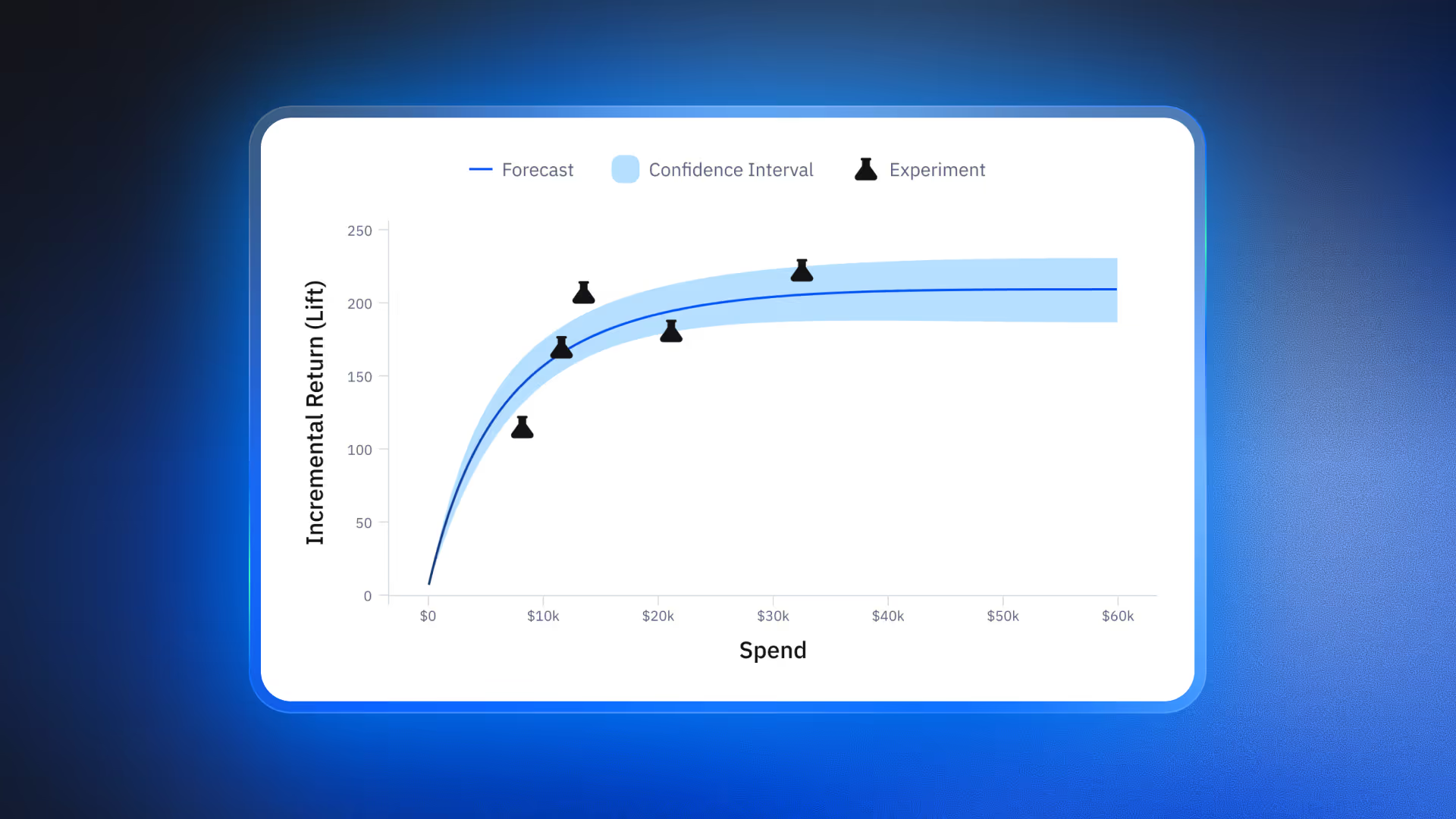
Statistical models — commonly regression-based or Bayesian — are used to estimate the relationship between marketing spend and business outcomes. These models can capture nonlinear effects, such as diminishing returns and delayed impact. Bayesian approaches, in particular, produce credible intervals that quantify uncertainty and increase confidence in the results.
Step 4: Estimate incremental impact & run simulations
Once the model is calibrated, MMM estimates the incremental contribution and ROI of each channel. Teams can then simulate alternative budget scenarios to forecast performance under different spend allocations. This helps teams pinpoint saturation points and informs strategic decisions about where incremental dollars will drive the most growth.
What are the key components of MMM?
These are the components that make up most marketing mix models:
- Base sales: These are the metrics that you would expect to see in the absence of marketing. Your general brand strength and repeat customer behavior help determine your base sales performance.
- Incremental lift by channel: Now marketing comes into the picture. Incremental lift measures the impact of marketing on your base sales. These metrics help you compare ROI across different channels.
- Diminishing return curves: A basic axiom of marketing is that each dollar added produces less impact over time. But at what spend level do sales peak? Your diminishing return curves help you optimize spend so that you aren’t wasting ad dollars.
- Time-varying return curves: These are essentially an extension of diminishing returns that allow the shape of the response curve to change over time. They describe how the same spend can produce different levels of incremental impact in different periods.
- Adstock/carryover effects: How does the impact of advertising persist beyond the period in which the spend occurs? Carryover effects capture how marketing exposure continues to influence consumer behavior over time, gradually decaying until its effect wears off.
- External control variables: Other factors influence business outcomes, including seasonality, competitor effects, promotional periods, macroeconomic impacts, and more. A marketing mix model should account for these external factors.
What are the benefits of MMM?
MMM has stood the test of time for a reason. Here are a few benefits of MMM:
- Privacy compliant: An MMM doesn’t require PII, which future-proofs this method against future tracking restrictions.
- Online and offline insight: You won’t just learn about the impact of digital channels like Meta and YouTube — you’ll also learn about performance on offline channels like linear TV, radio, out-of-home (OOH), and more.
- Accounts for incrementality (in some cases): If you’re using a Causal MMM (cMMM), you’ll understand the causal impact of your marketing instead of just correlation.
- Supports forecasting and long-term planning: The scenario planning built into modern MMMs helps guide long-term budget strategy.
- Works with partial/sampled data: Platform data can be limited, but many MMMs can fill in the blanks. And with a Causal MMM, you might be able to estimate the impact of channels you haven’t even tested.
What are the limitations and challenges of MMM?
Few measurement approaches are perfect. Here are a few of the limitations and challenges to keep in mind as you embark on marketing mix modeling:
- Onboarding may be slow: If you’re working with a Traditional MMM vendor, you may have to deal with an extended consultation period as they build your customized model.
- Extensive data requirements: Many Traditional MMMs require a substantial amount of historical data to build their models, which can be a challenge for younger startups or seasonal businesses. Lacking sufficient data can break models.
- Slower refresh cycles: This is mostly the case with Traditional MMMs, where infrequent updates (often monthly) struggle to keep pace with the business calendar.
- Lack of granularity: “Media planning is often granular, but MMM results often aren’t,” says Haus Principal Arthur Anglade. For instance, you can’t optimize your balance of Meta Prospecting campaigns vs. Meta Retargeting campaigns if you’re only getting insight into total Meta spend.
- Complex and often costly: Calibrating and running an MMM is a complex process that often requires teams of data scientists. While teams attempt to build MMM in-house, it usually requires specialized tools and expert vendors.
Key differences: MTA vs. MMM
The table below outlines some of the key differences between MTA and MMM.
When should you use multi-touch attribution?
Multi-touch attribution is best suited for organizations focused on digital performance optimization and near-term decision-making. MTA is particularly useful for journey analysis, helping marketers understand friction points and sequencing across the funnel, as well as for creative, audience, and message testing where fast feedback loops matter.
MTA can work in many industries, though it tends to work best in digitally native business models. Ecommerce brands, mobile apps, and digital subscription services often have the volume, velocity, and observability of user interactions needed for reliable attribution. MTA is most valuable when digital spend represents a large share of the marketing budget and when teams are running frequent experiments that require rapid optimization.
But keep in mind that MTA is not a fit for every situation. It tends to break down when:
- There is significant offline or brand spend
- Extensive cross-device fragmentation
- Insufficient data volume
- High privacy sensitivity, where user-level tracking is limited
When should you use marketing mix modeling?
Marketing Mix Modeling is best suited for strategic, long-term measurement and planning rather than day-to-day optimization. It helps answer macro-level questions about how marketing investments drive business outcomes over time — especially when multiple channels and external factors are involved. MMM is particularly effective for evaluating brand campaigns, understanding long-term impact, and guiding annual or quarterly budget decisions across both online and offline media.
Here are some popular use cases:
- Annual and quarterly budget planning
- Measuring brand and upper-funnel campaigns
- Evaluating mixed offline and online media
- Analyzing macro-level drivers of performance
MMM works best in industries with complex marketing ecosystems and significant offline investment. Retail, CPG, travel, healthcare, and financial services organizations often rely on MMM to understand how marketing interacts with pricing, promotions, seasonality, and broader market forces.
Can you combine MTA and MMM?
MTA excels at short-term optimizing, while MMM works best with long-term planning. Naturally, you might be wondering if you can combine MTA and MMM into a holistic measurement stack.
The short answer: Yes, but there are some factors to keep in mind.
To combine MTA and MMM, consider using MMM to set your channel budgets. Then, once you’re in the thick of the quarter, you might use MTA to guide in-channel optimization. Be sure to align around unified KPIs so that your conclusions are consistent. Together, you’ll generate omnichannel, incremental insights from MMM and granular, fast feedback from MTA.
Still, integration may be limited in the following ways:
- Offline effects remain difficult to isolate, especially when exposure data is incomplete or imprecise, limiting how well MMM insights translate into digital optimization.
- High data engineering requirements make integration complex, requiring tight alignment across data sources, timeframes, and metric definitions.
- Walled gardens restrict visibility, creating persistent blind spots that neither MTA nor MMM can fully overcome on their own.
- Lack of true causality remains a core limitation. Both methods are observational and only become causal when paired with rigorous experimentation.
What are the alternatives to MMM and MTA?
If MMM, MTA, or some integrated combination still comes up short for your organization, you may want to consider the following alternatives:
- Incrementality testing uses controlled experiments — such as geo experiments, platform lift studies, time-series tests, and fixed-geo tests — to directly measure causal impact rather than inferred contribution.
- Unified measurement frameworks combine MMM, MTA, and incrementality tests into a single system and are typically adopted by more mature organizations seeking both strategic and tactical insight.
- Platform attribution calibrated with MMM or experiments starts with platform-reported ROI and adjusts it using causal measurement, making it a practical option when data access or signal quality is limited.
It comes down to causality. While MMM and MTA offer powerful benefits to marketing teams that want visibility into short-term and long-term performance, they offer the most insight into the true ROI of your marketing efforts when built on a foundation of best-in-class experiments.
Frequently asked questions
1. What is the main difference between multi-touch attribution and marketing mix modeling?
The main difference between multi-touch attribution and marketing mix modeling is that MTA analyzes user-level digital interactions to assign credit across touchpoints, while MMM uses aggregated historical data to estimate the incremental impact of channels on business outcomes. As a result, MTA is better suited for short-term digital optimization, while MMM is designed for long-term, cross-channel strategic planning.
2. Which is more accurate: multi-touch attribution or marketing mix modeling?
Ultimately, it depends on what you’re measuring. Marketing mix modeling is more accurate for evaluating brand campaigns and understanding long-term impact, while MTA offers more granular insight into the performance of digital marketing.
3. Are MTA and MMM the only options?
No, many marketing teams are leveraging incrementality testing to gain insight into the causal impact of their marketing. Causal MMM is also a growing alternative to Traditional MMM. Causal MMM treats experiments as ground truth for its recommendations.
4. Can you use both MTA and MMM together?
Yes, MTA and MMM are good candidates for integration. MTA can offer granular, in-channel insight into performance, while MMM can help guide longer-term budgetary decisions.
5. How do I choose between MTA and MMM?
The short answer: You don’t have to. Both offer compelling benefits for businesses and can be integrated if necessary. That said, companies that invest more in offline media and brand campaigns should prioritize MMM, while brands where digital spend represents a large share of the marketing budget and rapid optimization is necessary should prioritize MTA.
.jpg)


.png)











.avif)
.avif)

.avif)

.avif)

.avif)
.avif)
.avif)


.avif)


.avif)


.avif)
.avif)
.avif)
.avif)
.png)
.png)
.avif)


.avif)
.avif)
.avif)
.avif)
.avif)
.avif)

.avif)

.avif)

.avif)

.avif)
.avif)
.avif)
.avif)
.avif)


.avif)
.avif)
.avif)
.avif)

.avif)
.avif)
.avif)

.avif)

.avif)
.avif)
.avif)
.avif)


.avif)


.avif)
.avif)



.avif)
.avif)
.avif)


.avif)
.avif)
.avif)
.avif)
.avif)
.avif)




.png)
.avif)