Three Lessons Marketers Can Learn From a Failing Football Club
What Tottenham’s collapse reveals about the right — and wrong — way to use advanced analytics.
Apr 27, 2026

ESPN recently released a story detailing how Tottenham Hotspur, one of the world’s richest football clubs, is undergoing one of the most stunning collapses in the history of sport.
Just twelve months after winning the UEFA Europa League, they have plummeted to 18th place in the Premier League and are on the verge of being relegated to a lower division, a result that would crater the club’s revenues and plunge them further into crisis.
You might be wondering what the connection is between this story and marketing: As it turns out, Tottenham’s sudden reversal in fortune comes down to how they are using (or misusing) advanced analytics.
Rather than focusing on the player attributes that are most directly tied to outcomes (like shot creation), Tottenham shifted to measuring the attributes that align more with their scouts’ eye-test (like athleticism and off-ball movement). The club quite literally took their eye off the ball and they are now paying dearly for it, incurring the ire of fans and facing down a multi-year setback.
The story maps cleanly to a common marketing failure: Choosing the metrics that are easiest to see over the ones that actually drive business outcomes. So we wanted to call a quick huddle and outline three lessons marketers can learn from this cautionary tale of how not to use data to make decisions.
Three lessons for data-driven decision making
#1: Obsessively focus on what drives outcomes
The most fundamental error that Tottenham made was placing too much emphasis on physical metrics that capture players’ athleticism and endurance as opposed to measuring their ability to create scoring opportunities. The latter is much fuzzier to measure because it’s fundamentally mixed up with things like their position, their teammates’ ability, and the opposing team’s scheme – but it has a much more direct impact on winning games.
I liken this to focusing on vanity metrics like traffic and conversion rates over outcome metrics like incremental lift. If you over-optimize to the channels driving the cheapest traffic, conversion rates crater. If you over-optimize to the channels with the best conversion rates, traffic dwindles. By not focusing on the outcomes that actually matter — incremental sales — businesses find themselves in a never-ending game of seesaw trying to balance metrics that have no intrinsic value.
Incremental lift, on the other hand, is not highly visible. In fact, the most incremental channels often drive little to no trackable traffic and shockingly low conversion rates, as we’ve shown in prior studies. These channels are the Lionel Messis of your marketing mix: Easy to underrate if you’re only measuring the obvious physical traits, but impossible to replace once you understand how much better they make everything around them.
Metrics like CPMs and CTRs are helpful indicators for tactical optimization, but don’t let them distract you from measuring and budgeting based on what truly matters – incremental business outcomes.
#2: Separate luck from signal
Soccer, like marketing, is a noisy game. A single match can swing on a bad bounce or a deflection, which is why expected goals (xG) is a better predictor of future performance than wins and losses. xG predicts the probability a shot will go in based on thousands of similar historical shots – accounting for factors like distance, angle, and body part. It doesn’t provide a tidy, deterministic story, but it signals whether you’re on the right track to winning.
During Tottenham’s first season after Johan Lange took over as technical director in 2023, their xG differential regressed from +7.4 to +3.1. However, due to some lucky bounces, they actually improved their position in the final standings from 8th to 5th. A prudent organization would have realized these results were not repeatable and reconsidered its player acquisition strategy before the next season. Instead, Lange doubled down on athleticism over chance creation and, this time, luck wasn’t enough to save them from a drop to 17th in the standings.
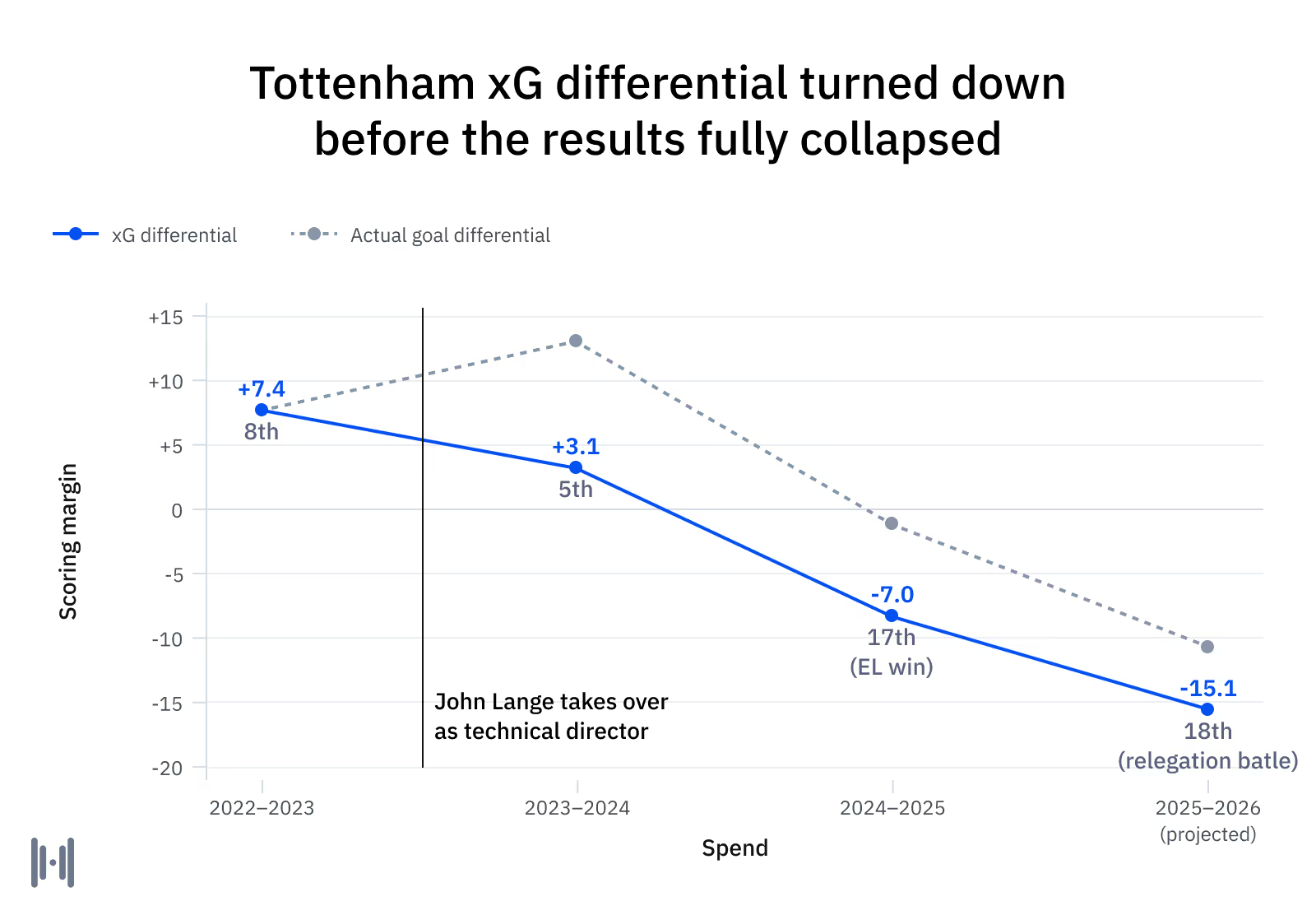
What did save Lange’s job was an improbable Europa League run, where Tottenham overperformed their xG by more than any other team in the competition. The trophy masked the underlying decay, delayed the scouting overhaul that was clearly needed, and set up the collapse we're watching now.
Marketers often fall into the same trap. When sales are up, it's tempting to assume the marketing strategy is working. When ROAS prints 2.0x in the ad platforms, it's tempting to call it a win. But just like a league finish, those numbers are not the full story – there are myriad other forces influencing short-term success that have nothing to do with whether budgets are optimally allocated. What marketing leaders actually need is the equivalent of xG: a measure of whether you're making the right bets, separate from whether the scoreboard happened to reward them.
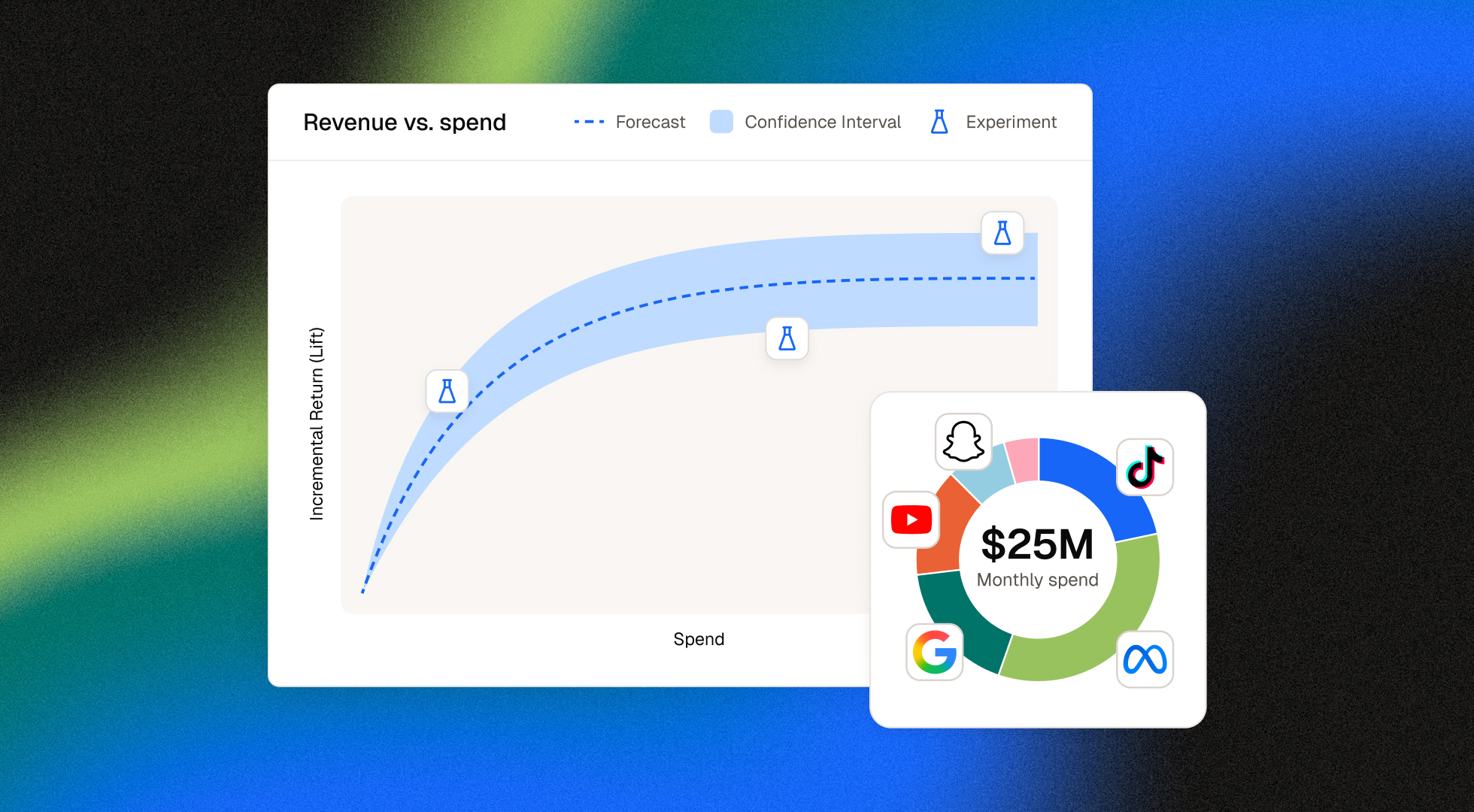
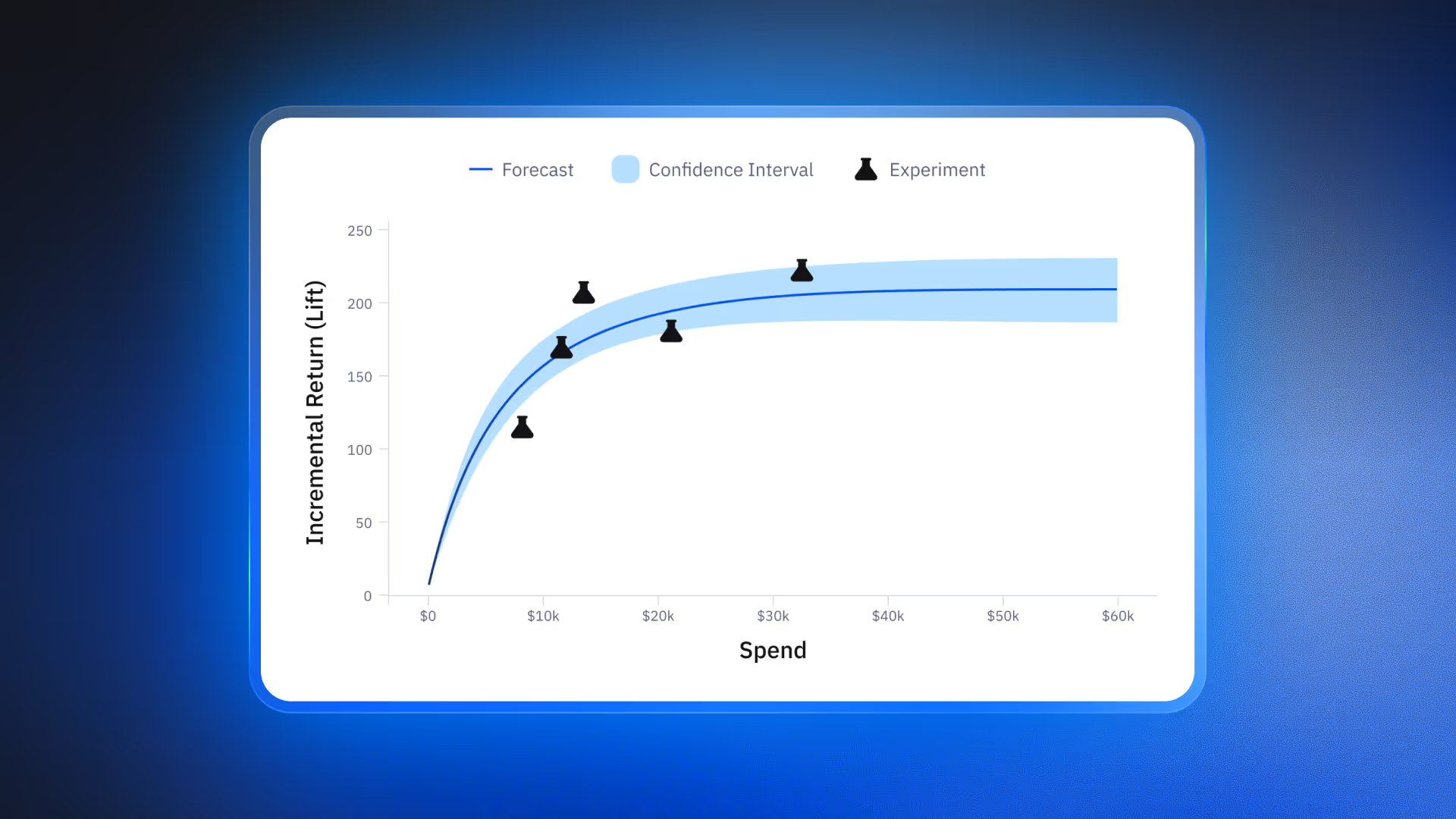
The catch is that the equivalent of xG – incrementality – requires you to think probabilistically, something most marketers are not trained to do. Performance readouts from ad platforms or MTA offer the comfort of false precision: 2.0x ROAS = 2.0x. Incrementality gives you something messier and more honest: “an 80% probability range of 1.2x–1.8x, with a 1.5x iROAS point estimate.”
We all know which of these outputs is easier to explain to an exec, but easier to explain is not always better for business. The uncertainty in an incrementality readout can make marketers nervous about acting on it, but the case of Tottenham illustrates exactly why running away from uncertainty into the comforting arms of biased data is so risky.
A single incrementality result in isolation may be noisy, but consistent action on these results compounds, with each test nudging your marketing strategy towards the optimal allocation over time.
#3: Use data to guide decisions, not justify them
One of the more telling stories from Moneyball – and one the ESPN piece opens with – has nothing to do with Billy Beane. In the late 1970s, the Houston Astros commissioned a study on whether moving their outfield fences in would help the team win more games. The study came back: Given their roster, it would actually cost them games. Houston's response? Bury the study. They'd already decided to move the fences in; they just wanted data that backed them up.
Whether it’s cherry-picking upper-funnel metrics to defend a failing channel or putting a thumb on the scale to inflate a channel's credit in MTA or MMM, these behaviors are the marketing equivalent of burying the Astros study. They confirm gut assumptions instead of testing them and, over time, they rot the foundation of your marketing program from within.
The beauty of incrementality is that while it often delivers hard truths you don’t want to hear, it also affords your gut assumptions a fair shot to prove themselves. I’ve written about my instinctual belief in YouTube before, but it’s a channel that often doesn’t perform well on the first try. You need to first lock in your creative, audience, and signal engineering strategy – only then is the true potential of the channel revealed. An inefficient test result isn’t a death sentence; it’s an invitation to revise and retest until the data catches up to your instincts, or until you accept that it won’t.
The most important lesson here is to not hold your assumptions too dear. The path towards growth starts with curiosity and humility. Instincts do have value, but they should work in concert with data, not in conflict with it.
The grand vision
“If you’re running a team and you can figure out how to combine these physical metrics with what drives winning and scoring goals, then you’ve created a new, much more holistic understanding of player value, and you’ll have a leg up on anyone who is only using passing and shots to quantify performance. But that’s really hard, and since it’s really hard, it’s not really happening.”
O’Hanlon’s last point here is salient. Soccer and marketing are complex, chaotic systems with too many moving parts to ever be fully predictable. The temptation in both is to retreat to the metrics that feel like answers – athleticism scores, ROAS, CTRs – because the real answers are messy, probabilistic, and sometimes unflattering.
But the teams (and brands) that win over the long run are not the ones looking for a single magical metric. They are the ones building better decision systems. Systems that stay anchored to outcomes, distinguish signal from luck, and let assumptions survive only when the evidence supports them.
Tottenham forgot to ask the question that mattered: But can he pass?
Don’t let your marketing program forget to ask: But is it incremental?
Subscribe to our newsletter
Article tags
Article authors

Tyler is Head of Strategic Insights at Haus. With a decade of experience in marketing, he has spoken at The Lead Innovation Summit and Google’s Rethink ROI, and has authored numerous reports on marketing measurement.




.jpg)

.png)









.avif)
.avif)

.avif)

.avif)

.avif)
.avif)
.avif)

.avif)


.avif)


.avif)
.avif)
.avif)
.avif)
.png)
.png)
.avif)


.avif)
.avif)
.avif)
.avif)
.avif)
.avif)

.avif)

.avif)

.avif)

.avif)
.avif)
.avif)
.avif)
.avif)


.avif)
.avif)

.avif)
.avif)

.avif)
.avif)
.avif)

.avif)

.avif)
.avif)
.avif)
.avif)


.avif)


.png)
.avif)



.avif)
.avif)
.avif)


.avif)
.avif)
.avif)
.avif)
.avif)
.avif)