The TikTok Report
Can TikTok scale? How much omnichannel impact does TikTok have? Haus’ analyses of hundreds of TikTok incrementality tests answers these questions and more.
Dec 4, 2025

Background
If you’ve been around the Haus block for a minute, you’ve probably noticed we like asking questions around here. In the past, we’ve dug into incrementality experiment data from platforms like YouTube, Branded Search, and Meta. This time, we wanted to learn more about TikTok.
In the world of growth marketing, there are a handful of TikTok-related questions we hear every so often. For example:
- Do I need TikTok to succeed?
- Can TikTok scale?
- Is TikTok “demand capture” or “demand creation?”
- How much omnichannel impact does TikTok drive?
- Is TikTok a strong investment during promotional periods?
- Is TikTok a strong new customer acquisition channel?
And so: We decided to do something about it. Let’s dive into these areas (and then some) to see what we can learn from the brands who have effectively woven TikTok into their media mix. From common characteristics they share to patterns we see in experiment data and business outcomes, let’s get into it.
About the data
- We analyzed hundreds of Haus experiments across 2.5 years of data
- The average experiment length was 21 days
- The average post-treatment window (PTW) length was 9 days
- The average advertiser in this study spends nearly $3 million annually on TikTok.
- Advertisers span an array of brands across Media, Apps, Gaming, Ecommerce, Health & Wellness, and Retail verticals
Finding the TikTok spend sweet spot
TikTok has been available in the United States since August 2018 – making it active for about 7 years at the time of this writing. To say nothing of it falling into geopolitical crosshairs, it has grown considerably as an advertising channel in a relatively short period of time. By the end of 2025, TikTok’s global ad revenue is projected to reach ~$33 billion.
When brands started running experiments on Haus in 2021, TikTok was a marketing wild card. Today, it’s our third-most tested channel after Google and Meta.
Not every brand tests TikTok frequently. But across brands who have run 3+ Haus incrementality experiments on TikTok, they have on average scaled TikTok by an additional 13% beyond their first-test baseline spend, relative to other digital channels in search and social.
How does that shake out? This subset of brands started with an average 11% of their search and social spend going towards TikTok. By the second test, often buoyed by strong incremental efficiency, they scaled to an average of 15%. However, this seems to be where they surpassed the point of efficient marginal returns, as this subset of brands settled on 13% of average search and social budget share on TikTok across subsequent tests.
You might read this and wonder, “Aren’t 11%, 13%, and 15% in the same general ballpark? How much does this difference actually matter?” The magnitude of this change could be quite significant – after all, the relative difference between 11% and 15% represents a ~36% increase in spend at the channel level. When brands are spending tens of millions of dollars across their portfolio, these seemingly small differences in optimal spend share represent significant swings in how much money is being efficiently vs. inefficiently invested.
It’s also worth emphasizing that these are averages; on average, brands slightly scaled up TikTok spend after testing, but some scaled down while others scaled up significantly. There’s only one way to determine which of those groups you belong in – and that’s with a well-constructed incrementality test (or multiple).
Brands advertising on TikTok see performance strengthen over time and ahead of promotional periods
One of the clear takeaways that emerged from the TikTok tests we analyzed was the impact that post-treatment windows and promotional periods have on incremental outcomes.
Think about post-treatment windows as a period of time to gauge lagged or delayed effects. Across Haus TikTok incrementality experiments, brands observed an additional 68% lift to their primary KPI in the post-treatment window.
With TikTok, there is a slight observed impact through the first half of the experiment, but lift blooms by 247% on average in the second half and post-treatment window as demand created in the first half is realized. This effect closely resembles similar behaviors we’ve seen on channels like YouTube, which suggests brands may want to think about TikTok as something closer to a top-of-funnel channel, rather than, say, Meta, where effects are near-immediate and capture existing demand in the market.
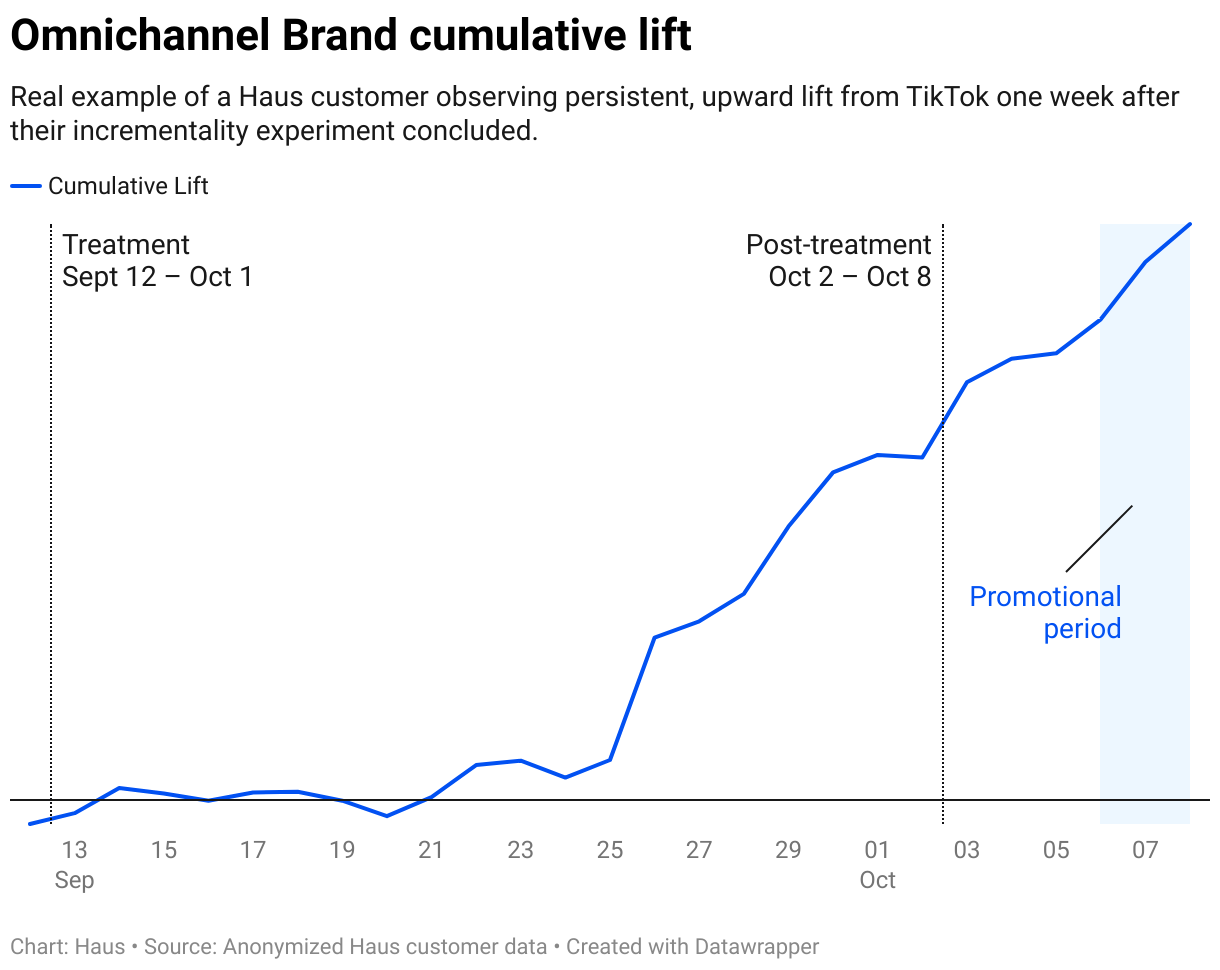
Let’s examine two representative experiments that illustrate this. In the graph below, we see anonymized data from Omnichannel Brand. The cumulative lift graph totals the observed lift each day to show the differences between treatment and control, and how consistent that difference is day over day. For the first half of the experiment, impact was negligible. As we continue into the second half of the experiment, we start to see real impact emerge. And as we cross into the post-treatment window, we see continued upward impact that extends into their promotional period.
In this second example below, we see anonymized data from a Long Consideration Cycle Brand, a DTC company that sells $400+ products on its website and Amazon. Long Consideration Cycle Brand ran a month-long experiment with Haus to measure the incremental impact of TikTok, but without a post-treatment window.
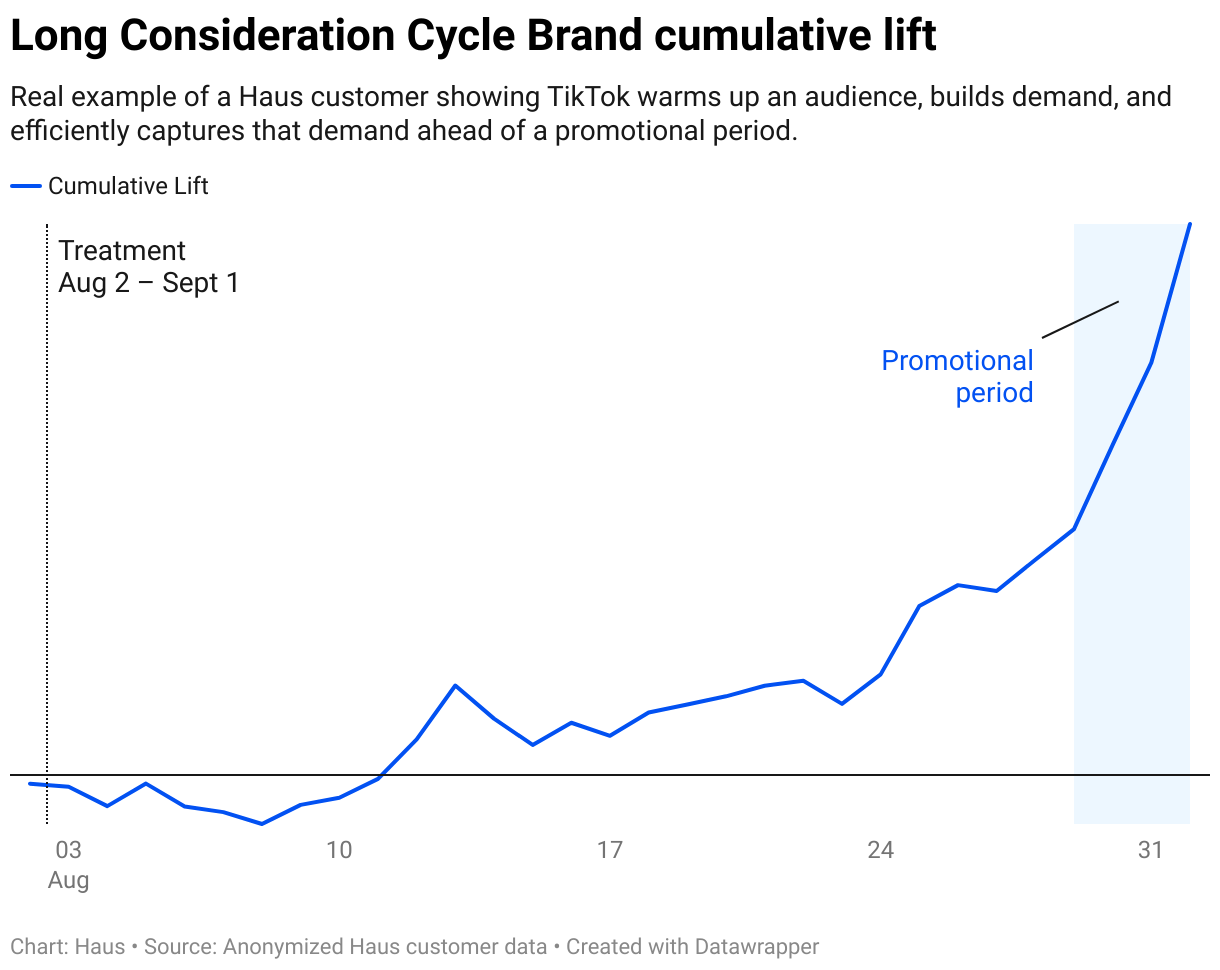
Similar to our first example, we see only modest impact in the first half of the experiment, with little difference between the treatment and control groups. In the second half of the experiment, we started to see a small upward impact emerge, but it wasn't until the last three days – a promotional period – where almost all of the impact from the media was measured.
Both of these experiments represent a pattern where TikTok warms up an audience, builds demand, and efficiently captures that demand ahead of a promotional period. In both cases, these experiments seemed doomed for failure halfway through – but patience and the introduction of a promotional period painted a different story in business outcomes.
Brands seem to be wise to TikTok’s apparent asymmetric seasonal performance: Haus customers advertising on the platform have on average turned off spend for 14% of weeks so far this year. Further, the average delta between BAU spend and peak spend on the channel is 5.0x – speaking to brands’ instincts to pull back after a high period and lean away from an “always on” evergreen strategy.
TikTok fuels strong omnichannel halo effects and balance across acquisition and retention
Many brands suspect strong halo effects across their media mix (that is, identifying the impact that marketing spend in one place has on sales in another), but quantifying this isn’t always easy. In our analysis, we confirmed TikTok has a demonstrable impact on omnichannel sales for DTC brands. Additionally, TikTok seems to be a relatively balanced channel in terms of driving new vs. existing consumer activity.
TikTok drives halo effects on Amazon and in retail
What impact does advertising on TikTok have across other sales channels like Amazon and retail? For brands hoping the answer is positive, you’re in luck: Our experiment analysis shows that TikTok delivers nearly twice as much value – 1.9x – when brands look at omnichannel impact rather than measuring DTC lift alone.
For brands selling across DTC, Amazon, and retail, TikTok on average drove an additional 34% of sales to Amazon and 57% of sales to physical retail. That means for every dollar captured in ecommerce, an additional $0.34 of incremental sales was generated on Amazon, and $0.57 of incremental sales for brands selling in retailers such as Target, Sephora, Best Buy, Ulta, Nordstrom, and others.
By organizing and analyzing retail and Amazon KPIs, TikTok advertisers gain a comprehensive understanding of the omnichannel incrementality picture, enabling them to scale TikTok spend with greater confidence and quantify additional impact.
TikTok powers incremental sales for both new and returning customers
Finding new audiences for a scaling brand is no easy feat. Across experiments analyzed for DTC brands, we found that 62% of TikTok- lift drives new customer sales, making it a reasonably balanced channel with a slight lean towards new customer acquisition.
Characteristics of brands that successfully scale TikTok
It’s one thing to find that sweet spot where paid media on TikTok starts driving incremental outcomes – but it’s another to step back and consider how (or if) TikTok strategically fits into your media mix and business goals. For some brands Haus works with, TikTok has eclipsed even Google and Meta in ad spend share of wallet. Other brands have embraced TikTok as a smaller piece of their media mix puzzle, but successfully cracked the code on what makes it an incrementally effective business-driver.
In our analysis (and anecdotal experience), brands testing on TikTok that have been able to successfully, incrementally scale typically share these characteristics:
- Demographics: They target Gen Z and younger Millennials
Brands targeting Gen Z spend 2.7x more budget than brands targeting other generations. - Price point: They offer lower-consideration products and services
Advertisers with an average order value (AOV) of less than $50 spend 2.8x more budget than advertisers with AOVs greater than $50. - Core offering + creative: Their value proposition is easily demonstrated in short clips
Businesses who can show brand value in short clips spend 1.5x more budget than businesses that fail to convey their value concisely. - Time to value: Their business model allows for low-friction onboarding or trials
Services offering free trials spend 1.8x more budget than services requiring users to pay upfront.
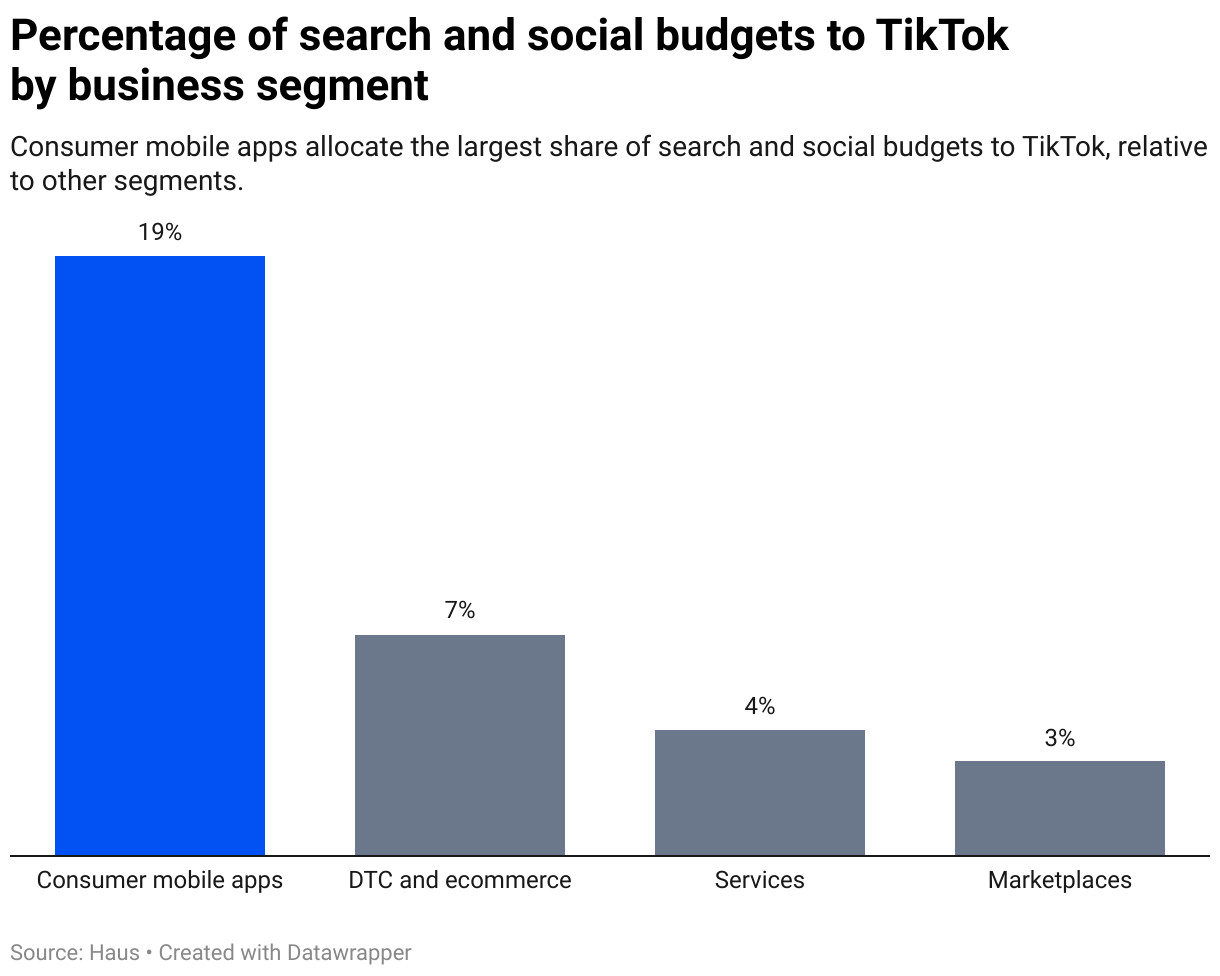
Looking across business segments, data shows that app-based and B2C (business-to-consumer) brands allocate the largest share of search and social budgets to TikTok, relative to other segments. We see that on average, this segment devotes 19% of their search and social spend to TikTok.
How brands can act on these findings
What’s a brand to do with all of this data, and how can you take these learnings and apply them to your business? We recommend keeping these key things in mind:
- Match TikTok’s strengths to your business. Brands that scale TikTok successfully share several common characteristics: Low-friction offers, simple value propositions, and Gen Z-friendly positioning. Evaluate your potential TikTok fit by audience and offering.
- Plan for delayed impact. TikTok’s influence builds over time, often paying off after a marketing activity ends. Extend your experiment’s observation window and resist the urge to cut spend too early.
- Pair TikTok with promotions. TikTok primes audiences and captures demand ahead of promotional or seasonal windows (ahem, Black Friday). Use the platform to build momentum ahead of a key sales period.
- Optimize for omnichannel lift. TikTok drives meaningful incremental value off-platform. Track omnichannel KPIs (retail, Amazon, DTC, etc.) so you can evaluate business impact holistically.
- Convert curiosity. Brands that simplify their value proposition into short clips can win big. Prioritize creative that clearly spells out benefits to your audience, and make sure you can capitalize on audience interest with fast time-to-value on the other side.
Last but not least: Experiment your way towards TikTok efficiency. Every brand is different – what works for one brand may not work for another. Use continuous experimentation to your advantage and find the optimal spend level for your business.
And with that, we’re back off to scrolling #ForYou – purely for research, of course.
Subscribe to our newsletter
Article tags
Article authors

Patrick is a Senior Solutions Consultant at Haus. With 18 years of experience spanning analytics, marketing, and B2B SaaS, Patrick has led multiple 0-to-1 product launches and founded two ventures that each ended in acquisition. He brings a rare combination of technical depth, working fluidly with data science and engineering teams, and a strong customer-facing instinct.

Tyler is Head of Strategic Insights at Haus. With a decade of experience in marketing, he has spoken at The Lead Innovation Summit and Google’s Rethink ROI, and has authored numerous reports on marketing measurement.

Emily K. Schwartz leads Content and Brand at Haus. Her career began in journalism (NPR, Politico, The Washington Post, several magazines) before shifting into product management (AddThis/Oracle Data Cloud, Capital One, several startups) and ultimately comms, content, and brand. Originally from outside of Philadelphia, Emily currently lives in Northern Virginia and enjoys all things Philadelphia sports, tennis, travel, and style.



.jpg)

.png)









.avif)
.avif)

.avif)
.avif)

.avif)
.avif)
.avif)


.avif)


.avif)


.avif)
.avif)
.avif)
.avif)
.png)
.png)
.avif)

.avif)
.avif)
.avif)
.avif)
.avif)
.avif)

.avif)

.avif)

.avif)

.avif)
.avif)
.avif)
.avif)
.avif)


.avif)
.avif)
.avif)
.avif)

.avif)
.avif)
.avif)

.avif)

.avif)
.avif)
.avif)
.avif)
.avif)


.png)
.avif)


.avif)
.avif)
.avif)


.avif)
.avif)
.avif)
.avif)
.avif)
.avif)