How Film Studios and Streamers Measure Marketing ROI
We analyzed dozens of incrementality experiments to learn how leading studios and streaming platforms use testing to answer the questions that matter most.

Jun 25, 2026

Studios and streamers are fighting for the same elusive prizes: consumer attention and share of wallet. A film today doesn't just compete with what else is playing; it competes with every other way someone could spend a few hours and twenty bucks. For streaming platforms, the challenge runs even deeper; with nearly half of Americans canceling a streaming service in the past year, winning a subscriber means nothing if you can't keep them.
That puts enormous weight on marketing teams to effectively drive people to the box office or to subscribe and stay. But knowing whether marketing campaigns actually influenced customer behavior is extremely challenging. The moments that drive the biggest results — the latest film release from a beloved franchise, a live sporting event, a hit show dropping its latest season — are the same moments that make marketing’s impact even harder to quantify.
Did someone need to see a YouTube ad to purchase tickets weeks later to see Toy Story 5, or would they have gone anyway? Would someone have subscribed to a streaming service because they saw a billboard advertising its World Cup coverage? For a non-tentpole release, does investing in media after a film’s release actually work, or is it just lighting money on fire?
These are exactly the kinds of questions Haus is built to help answer. We've helped marketing and analytics teams at film studios and streaming platforms move from fuzzy post-campaign debates to clear causal answers — designing experiments around real business constraints and tying measurement to outcomes that actually matter. In this report, you’ll see how we’ve partnered with these powerhouses across dozens of experiment analyses conducted between 2025 and today to uncover insights that haven’t been accessible to most media and entertainment companies before.
Marketing effectiveness trends for feature films
We know marketing measurement is tough. But for studios, connecting advertising dollars to revenue has been nearly impossible. Marketing campaigns for theatrical releases typically span dozens of upper-funnel, hard-to-track channels and run on compressed timelines, with most of the budget spent before there is a conversion action to measure.
Geo experiments are the gold standard for establishing causality, but theatrical releases create a structural challenge for standard geo testing. A conventional experiment works best when test and control markets can be validated against a long pre-treatment baseline, which typically requires several months of stable historical KPI data. Films do not behave that way. Every title is a new launch, campaign windows are compressed, and there is rarely enough title-specific history to support a traditional design.
This is a classic cold start problem. Haus has addressed this by expanding our GeoLift methodology for use cases with little to no historical data, such as film releases, new product launches, or market expansions. Using comparable KPIs and anchor dates in place of a traditional historical baseline, Haus can obtain a clean causal estimate of how a specific marketing decision affected box office performance.
The analyses in this report draw on experiments conducted during campaigns across several major studios and are designed to answer a practical question: What is the actual incremental impact of marketing on box office performance? Marketing campaigns were tested to determine the effectiveness of channels such as YouTube, TikTok, Meta, Google, Reddit, The Trade Desk, and Snap, as well as combinations and spend levels of these platforms. Across these studies, the primary outcome was incremental box office revenue attributable to the media being tested. Search volume was also observed as a potential early indicator of consumer response and was later validated against downstream performance.
What follows is a snapshot of how film marketing performs when measured causally. The first question is whether marketing worked. The second is whether the budget was right. In both cases, the results gave studios something specific to act on. The answers changed how these studios planned their next release.
Franchise films vs. original IP
One of the more interesting patterns to emerge from our dataset isn't just about how franchise films and original properties respond to paid media. It's about how studios have approached experimentation differently depending on the type of film they're marketing — and where there's room to learn even more.
For franchise titles, studios prioritized designing experiments to isolate the impact of a single platform: YouTube, TikTok, or Meta. For original IP, however, the approach has been different. Those experiments were designed to measure media mix performance: how a combination of channels drives impact, rather than any one channel in isolation.
These patterns likely reflect two factors: the studio’s learning priorities and operational realities. Franchise films carry built-in awareness and predictable demand, so the more pressing question isn't whether marketing works — it's which channels are pulling their weight. Isolating a single platform gives a clean efficiency signal before committing to a broader media strategy. Original IP, by contrast, has no established audience to lean on, so the central question is more holistic: Does this combination of channels move the needle enough to build awareness from scratch? A media mix experiment is better suited to answer that.
There's also a very practical side. Franchise titles may face more internal stakeholders and approval layers, making a single-platform holdout a simpler experiment to greenlight than a comprehensive media-mix holdout test.
Neither approach is wrong; both uncover key details about a studio’s marketing efforts that the studio can apply to similar future releases. But by running only one flavor of incrementality experiment for each type of release, they miss key details that could unlock even greater insights.
Search as signal
When running an experiment, you'd expect a large increase in search volume to produce a corresponding lift in ticket sales — just not at the same rate. That's the marketing funnel working as intended: awareness comes first, then consideration, then conversion, with natural drop-off at each stage. Searching for a film doesn't mean you're buying a ticket. But for franchise titles, we found something that flips that expectation: Box office lift consistently exceeded search lift. Incremental search volume ranged from 0.43% to 1.8%, yet this translated into a 1.2% to 3.7% lift in box office sales.
That result makes more sense when you think about who's actually watching these films. Franchise audiences already know the movie exists. They've seen the first, second, and third iterations. They may have a T-shirt featuring the face of the franchise’s main character, or a Funko Pop figure on their desk. They’ve had the latest release date marked on their calendar long before an ad ever appeared in their feed. The organic baseline for these titles is already elevated, which means paid media has less room to visibly move the search needle.
But when the film hits theaters, the data tells a different story. Meta, YouTube, and TikTok all drove higher incremental lift in box office sales than in search. Fans may have been aware and planning to go, but marketing during the theatrical window is what actually got them to buy the ticket.
Non-franchise titles told a more ambiguous story. Half followed the expected pattern — higher search lift, lower box office lift — but the other half showed the inverse. That 50/50 split is a useful reminder that search volume is a signal, not a guarantee. Interest doesn't always convert to a purchase, and sometimes a film drives real ticket sales without ever dominating search. The box office is its own measure of success, and it doesn't always move in lockstep with what people are typing into Google.
The impact of spend level experiments
Beyond incrementality testing, studios have also used Haus to run spend-level tests that analyze how increases or decreases in marketing investment affect box office sales. Unlike holdout-based incrementality studies, these tests focus on marginal returns, asking whether the current investment level is already capturing available demand or whether there is still room to push further.
It turns out most studio marketers already have a strong intuition for the pre-release spend level that maximizes box office sales. Baseline spend was the winning cell in 75% of tests, including tests comparing their planned spend against increased and decreased marketing budgets. That means that for most titles, the baseline budget was effectively the right call.
But one result told a different story: The studio behind an original IP title with strong box office potential wanted to understand the impact of spending an additional $50K across channels as chase media (paid media that continues to run after a film's release). This campaign generated a lift of 2.73% and a marginal return on ad spend (mROAS) of $4.70, a clear signal that meaningful headroom remained and that the tactic could scale further. Chase media has been relatively undertested by studios so far, but this experiment shines a light on an exciting opportunity to test and learn.

Five experiments worth running across any film slate
The insights above, and across our broader library of platform reports, reveal some clear patterns. But trends, however useful, can only get you so far. Every studio's audience, slate, and media strategy is distinct enough that the only way to know what works for you is through running a rigorous experimentation program.
At Haus, we’ve found that the studios getting the most out of testing aren't treating each experiment as a one-off read; they're compounding knowledge and building their own library of causal benchmarks. That studio-specific library is a competitive advantage: Each result adds a layer of context around what works by genre, budget tier, release window, and channel mix, so the next film starts with a stronger baseline and a new hypothesis to test.
With that in mind, here are five experiments worth considering as you build out your measurement roadmap. Think of them less as a prescribed list and more as a starting point — the right testing agenda is the one built around the questions that actually matter to your business, sequenced in a way that turns each answer into the foundation for the next experiment.
Baseline media mix
A baseline media mix test uses a holdout to separate organic from overall paid demand. It uncovers exactly how many incremental ticket sales occurred due to a studio’s marketing spend, and what sales would have happened anyway.
Platform incrementality
Once you know the overall media mix is moving the business, the next question is usually which platforms are actually earning their place in the plan. A platform incrementality test isolates one channel, such as Meta, YouTube, TikTok, or paid search, to determine whether it’s driving real lift or simply taking credit. This is often the fastest way to move from “We think this channel matters” to “We should fund more or less of it.”
Spend level
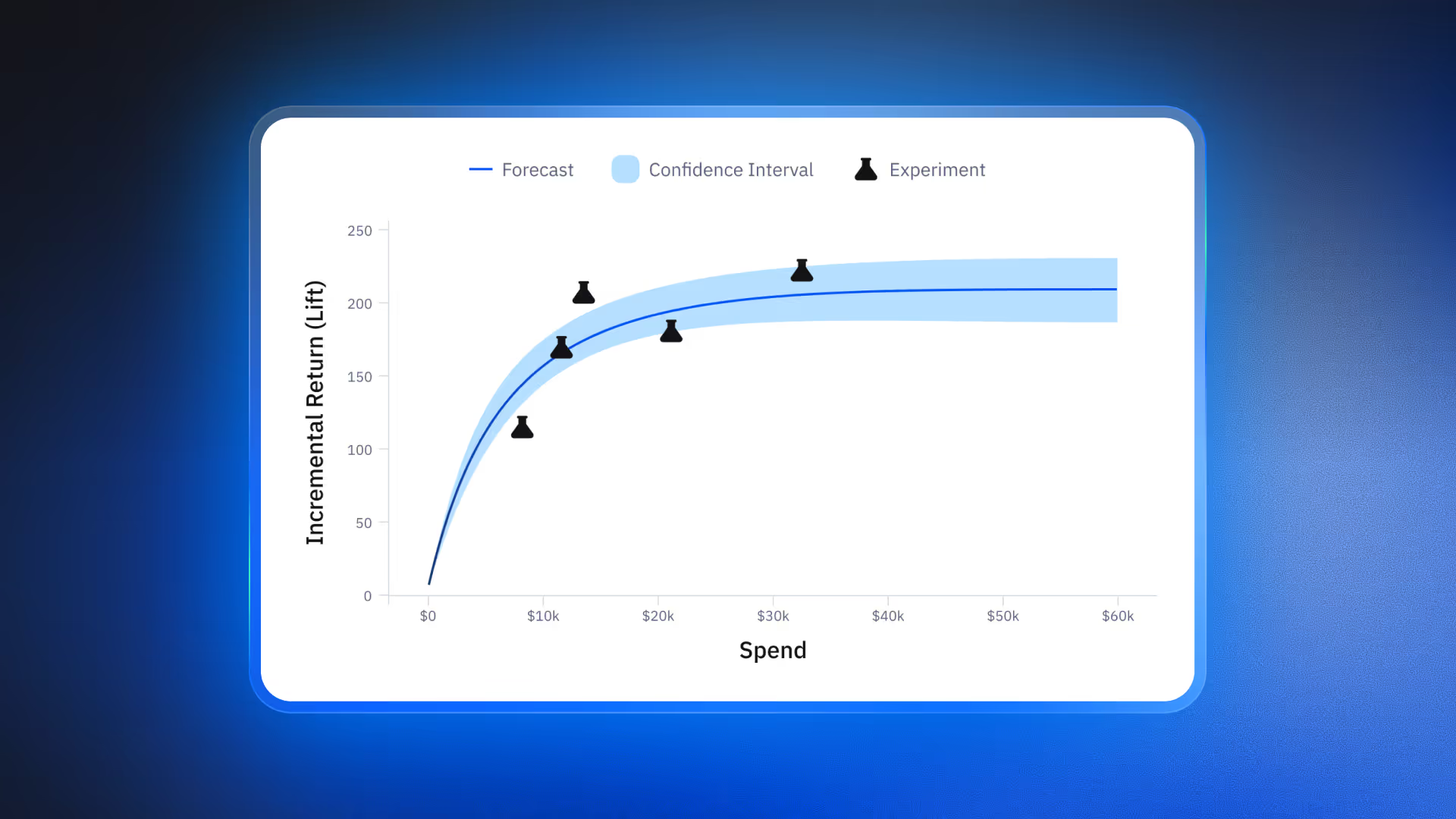
Spend level optimization experiments help you understand where you hit diminishing returns. For films, it’s important to keep spend changes meaningful. Small changes can be hard to detect in a short theatrical window, so 25% to 50% shifts are often more decisionable than tiny budget tweaks.
Chase media experiments
Chase media tests are some of the most practical experiments a studio can run because they address a real post-opening decision: Should we keep spending after opening weekend? Or are we just lighting money on fire?
New channel activation
New channel activation tests help studios pressure-test a channel they are not meaningfully using today, whether that is CTV, Reddit, programmatic video, or another emerging buy. These tests are important because new channels are where film teams often feel the most uncertainty and have the least trustworthy measurement signal.
With these tests on their roadmap, studios can answer some of their biggest questions about which channels move audiences, how to diversify their media mix, and when diminishing returns kick in. But those questions change considerably when the goal isn’t a one-off ticket purchase but an ongoing subscription. That brings us to our analysis of streamers.
Stream on: Why similar platforms produce different experiment results
On the surface, most streaming platforms look remarkably alike. They're all competing for users who want great content at their fingertips and are willing to pay a monthly fee (and/or sit through ads) to watch it. To win these customers, streamers typically invest in the same type of content: a mix of original and licensed content, as well as sports rights. Their biggest marketing pushes are often timed around the cultural moments most likely to drive sign-ups, such as major games they have rights to, awards season, or buzzy new shows. And then those campaigns run across the same core channels, chasing the same fundamental goal: acquire customers who actually stick around.
With all of those similarities, one might think that marketing teams could essentially run the same playbook across streaming platforms and expect broadly similar results.
But it's not that easy. At Haus, we’ve found countless examples of brands in the same category getting widely different experiment results, and streaming platforms are no different.
While one streamer found Meta to be their most efficient paid social tactic, another found it among their least incremental channels. It performed significantly below expectations — they were paying 4.4x more than anticipated to acquire paying customers on Meta. However, they found The Trade Desk OLV to be an extremely high-impact channel, a whopping 38.7x more efficient than they expected.
Those differences don’t happen by accident; they reflect deeper strategic choices about what each platform tests, where it invests, and how it defines success. Let’s explore some of the nuances.

Understanding the business: free vs. paid subscriptions vs. intro offers
Because streaming platforms operate on fundamentally different business models, they shouldn't expect the same experiment results or follow the same testing roadmap.
Free platforms like Tubi, Pluto TV, and Roku are optimizing for reach, engagement, and ad monetization — so their experiments naturally prioritize incremental viewers, watch time, and repeat usage. Paid platforms like Netflix, Apple TV, Disney+, and Peacock are built around subscriber economics, which means their tests need to be designed around paid sign-ups, CAC, and long-term subscriber value. From there, their testing roadmaps tend to focus on channel efficiency: cutting spend that isn't truly incremental, identifying emerging channels that can scale profitably, and rebalancing upper- and lower-funnel investment for sustainable growth rather than pure volume.
Trial- and discount-led services like Paramount+, Prime Video, and Fox One add another layer of complexity. The question isn't just whether marketing drives trial sign-ups — it's whether those trials convert to paid subscribers, and how channel, creative, and timing each influence that conversion. A channel that looks efficient on trial volume can look far less compelling when the KPI shifts to retained paying subscribers. That distinction has to be built into experiment design from the start, not discovered after the fact.
Brand maturity
Business maturity compounds this further. A newer streaming service faces a steeper climb entering channels where an established player already operates efficiently. That’s not because the channel is saturated, but because the established streamer arrives with something a newer one hasn't yet built: brand familiarity, embedded demand, and conversion momentum. That same media dollar simply works harder when there's existing awareness and intent behind it, with downstream behaviors like sign-ups, upgrades, and winbacks already in motion. A newer service often has to spend its way into that awareness before the channel can produce efficient paid outcomes at all.
What this means practically is that an established streamer is usually optimizing a mature system, while a newer one is still constructing one. The established player is running experiments to extract more value from proven demand; the newer one is often testing whether the channel can generate that demand in the first place. The same channel, the same spend, very different results — not because one is marketing better, but because they're starting from different places.
Content library
The programming a streamer has available on its platform shapes what kind of demand its marketing has to work with. A deep library, recognizable titles, or live news gives marketing more existing intent to convert. A platform without that depth may need its media to do more foundational work just to generate interest before conversion is even possible. That difference shows up not just in performance, but in what marketing is actually driving — one platform's spend may convert people directly into paid subscribers, while another's mainly drives trial starts or browsing, because the content creates a fundamentally different decision journey.
Sports rights are the most structurally consequential version of this. Live events create urgency that almost nothing else in streaming can replicate, driving people to sign up quickly and on purpose. But the nature of those rights matters. Exclusive access to a marquee game or league means marketing during that window has a tailwind a competitor simply doesn't have access to. One streamer ran an experiment that showed sports-targeted Meta campaigns outperformed news-targeted ones on both lift and efficiency, pointing to a higher-intent audience that was more responsive in that environment.
Together, these factors explain why no two streamers should expect to see the same results — and why the most valuable thing a platform can do before designing experiments is understand which of these dynamics are actually shaping its demand.
Finally, measurement feels good in a place like this
As we analyzed experiments across studios and streamers, the patterns we found resisted easy benchmarks and one-size-fits-all conclusions. That makes sense: the questions these companies need answered are shaped by very different business models, release strategies, and audience dynamics. What helps drive ticket sales for a franchise tentpole may say very little about how to launch original IP, just as a sports-heavy streaming slate calls for a different measurement approach than a trial-first subscription business.
That’s why the experiment should always fit the business question. The right design will naturally look different for franchise films, original IP, and streaming platforms at different stages of growth. And the real advantage doesn’t come from any single test result. It comes from building a repeatable system in which causal answers accumulate, learnings compound, and each test makes the next decision a little easier.
Subscribe to our newsletter
Article tags
Article authors

Tom O’Bara is Enterprise Measurement Strategy Lead at Haus, where he partners with global brands, studios, and other large advertisers on incrementality testing and marketing measurement. Before joining Haus, he led digital advertising strategy for brands including Prime Video, Audible, Kindle, and Echo at Amazon, bringing deep experience across ad tech and enterprise measurement to every engagement. Learn more about Tom’s work here.
.jpg)


.png)










.avif)
.avif)

.avif)
.avif)

.avif)
.avif)
.avif)


.avif)


.avif)


.avif)
.avif)
.avif)
.avif)
.png)
.png)
.avif)


.avif)
.avif)
.avif)
.avif)
.avif)
.avif)

.avif)

.avif)

.avif)

.avif)
.avif)
.avif)
.avif)
.avif)


.avif)
.avif)

.avif)
.avif)

.avif)
.avif)
.avif)

.avif)

.avif)
.avif)
.avif)
.avif)

.avif)


.avif)
.avif)


.avif)
.avif)
.avif)


.avif)
.avif)
.avif)
.avif)
.avif)
.avif)



.png)
.avif)