Is AppLovin More Than a Hype Channel?

AppLovin is proving it can drive efficient DTC growth — now the question is how durable that performance is as the channel matures.

Jun 18, 2026

Every growth marketer knows the feeling.

Meta is still Meta. Google is still Google. TikTok is no longer the new kid in class. Retail media networks are somehow both everywhere and still hard to evaluate. And every quarterly planning cycle seems to end with some version of the same question: Where does the next dollar of efficient growth come from?

The answer is rarely obvious. Most new channels either lack scale, lack proof, or look great in platform reporting right up until someone asks whether the sales were actually incremental. 

Enter AppLovin.

Long known as a mobile gaming ad network, AppLovin has more recently become one of the most discussed performance channels in DTC. The pitch is compelling: Massive mobile app inventory, unskippable video format, a powerful optimization engine, and a user base that many brands have not meaningfully reached through Meta, Google, or TikTok.

The early industry read has been unusually positive – eMarketer has covered AppLovin’s push into ecommerce as a meaningful growth opportunity.

But adoption and platform momentum are not the same thing as incrementality; the important question is whether the hype holds up when we look at actual business impact.

In order to do that, we analyzed 15 months (January 2025 - March 2026) worth of AppLovin incrementality test data across DTC and omnichannel brands spanning dozens of unique verticals to better understand where the channel performs well, where it is more limited, and how brands should think about scaling it from here.

The short version: AppLovin is real and often efficient, appearing especially strong for DTC. But it does not behave like every other channel in the media mix, a distinction that could determine whether the channel is a good fit for your brand. 

Understanding the data

Before getting into the findings, a few notes on the analysis:

  • The average AppLovin test in this sample ran at roughly $4.8K in daily spend.
  • The median test duration was 20 days.
  • During the test period, AppLovin represented a median of 4.6% of the brand’s paid media spend, with the middle 50% of tests ranging from 3.2% to 9.3%.
  • The average brand in the dataset was spending roughly $3M per month on digital advertising.
  • Unless otherwise noted, results are benchmarked against other channels each brand tested in Haus.

That last point is worth emphasizing: Rather than compare AppLovin against a generic benchmark or raw iROAS, we are looking to understand how it performs relative to the other channels the same brands have tested. This gives us a cleaner read on how AppLovin is earning its keep in the media mix. 

AppLovin is a strong DTC performer

The main finding is straightforward: AppLovin is performing well for DTC brands.

Across the tests we analyzed, AppLovin’s DTC efficiency was 1.11x higher than the average of other channels those same brands tested.

It also compares favorably when we look at where AppLovin ranks in the broader channel mix. AppLovin tests landed in the top quartile of channel performance 39% of the time, compared to an expected baseline of 25%.
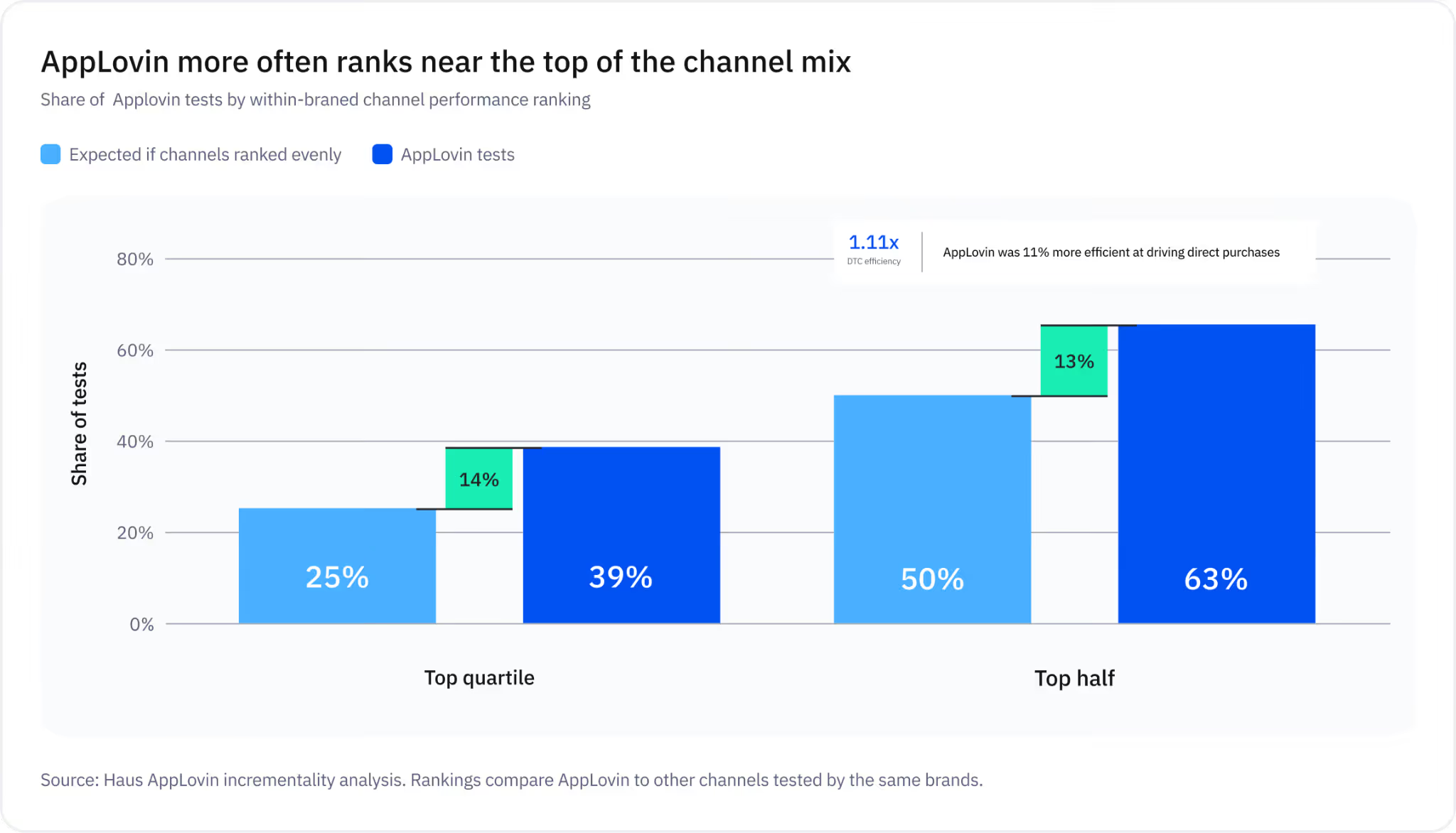
That is a strong result for a channel that is still relatively early in its DTC lifecycle.

Put more simply: AppLovin is not just occasionally working. It is often one of the best-performing channels in the mix. In many cases, it looks like a credible second or third best channel for brands that are trying to diversify beyond their core performance platforms.

AppLovin works quickly, and that can be a feature

One of the most interesting things about AppLovin is that its effects appear to be more immediate than many other channels.

At Haus, we have a feature called a post-treatment window (PTW) which allows brands to measure the latent or delayed effect of advertising on prospects in their funnel. 

Think of it as turning a standard holdout experiment into a longitudinal study: We continue to track the holdout group – prospects who have just gone weeks without seeing any ads – for a few extra weeks after the experiment to see how long it takes their demand to come back to baseline.

Across AppLovin tests, post-treatment window lift was 1.18x the treatment-period result. For other channels, the comparable figure was 1.39x.
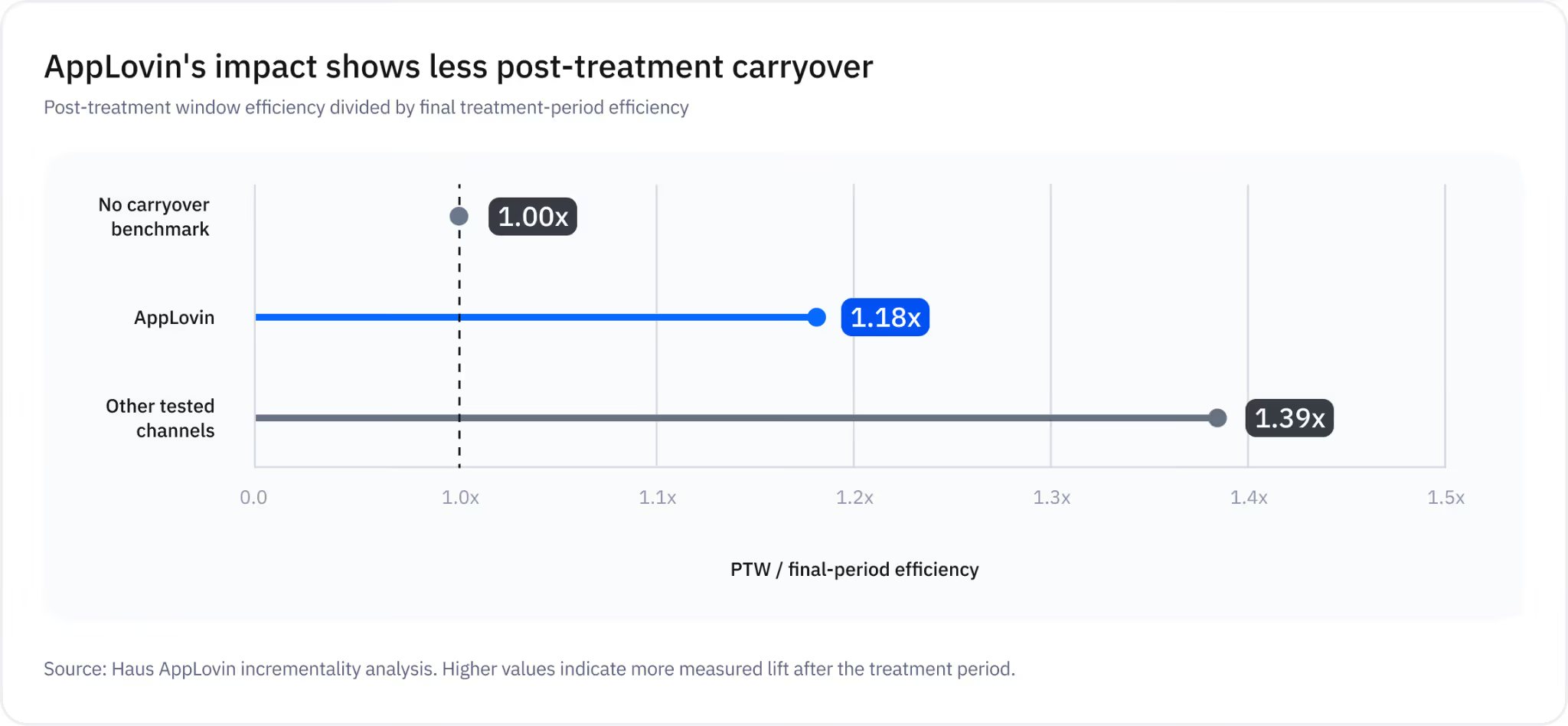
One way to frame that is that AppLovin has less latent impact than other channels. Another, equally valid way to frame it is that AppLovin appears to work quickly.

That distinction is worth noting because fast feedback is often valuable – a channel that drives most of its impact during the treatment period can be easier to evaluate, optimize and make budget decisions around. You do not necessarily need to wait as long to understand whether the channel is doing its job.

We often talk to businesses who need their marketing spend to pay back quickly based on cash conversion cycles. If this is the case for your business, Applovin’s ROI payback might be valuable. 

This is very different from a channel like YouTube or CTV, where impact may unfold over a longer period of time and show up across different sales channels. Those channels can be extremely valuable as well, but they require more patience and a different measurement lens.

AppLovin appears to sit closer to the performance end of the spectrum. Because AppLovin currently optimizes towards post-click attribution with no view-through, this structural difference may explain the shorter tail. For brands looking for short-term DTC impact, that’s a strength.

AppLovin drives a higher portion of lift from DTC relative to other media channels

The most constructive finding is that AppLovin’s impact does not appear to translate across sales channels as strongly as other tested channels.

For omnichannel brands in the sample, AppLovin drove a +25% halo effect beyond DTC. Other channels tested by the same set of brands drove a median +40% halo effect. (It’s worth noting that halo effects can vary meaningfully by brand and vertical.)
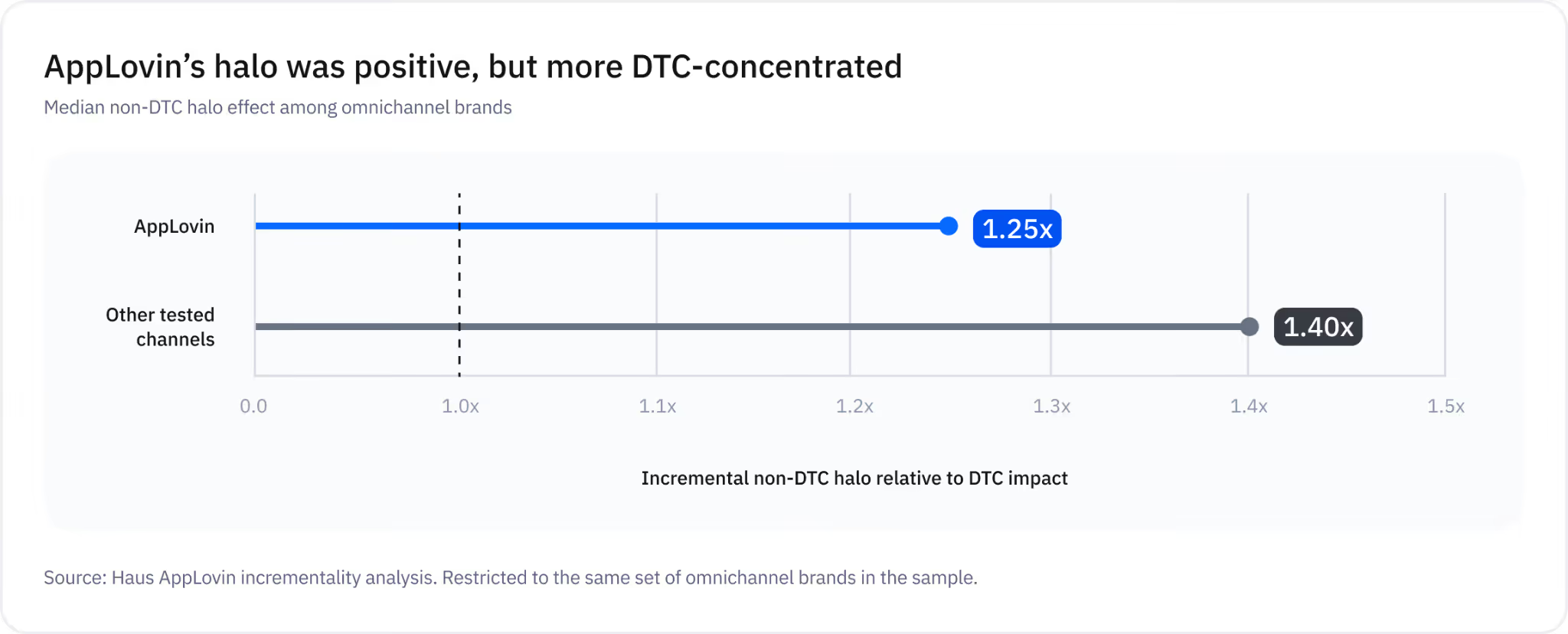
That gap is meaningful, but it is not especially surprising.

AppLovin’s ecommerce opportunity is built on performance-oriented mobile app inventory. Users are in a mobile environment and the ads are often direct-response oriented. In that context, it makes sense that AppLovin would drive more dot-com sales than delayed Amazon, retail, or wholesale impact.

This is where brands need to be precise about the job they are hiring the channel to do.

If the goal is efficient DTC acquisition, AppLovin is often well-equipped. If the goal is broad omnichannel demand creation, the data suggests brands may benefit from having more conservative expectations.

AppLovin shines as a net-new acquisition channel 

A common concern with any up-and-coming performance channel is that it may simply be capturing demand from existing customers rather than growing the customer base. 

The new-versus-repeat data does not suggest that is the dominant story here.

Across the AppLovin tests we analyzed, new customers represented roughly 66.3% of DTC impact. That was very similar to other tested channels — AppLovin had a higher new-customer share than the brand’s tested channel median 51% of the time.
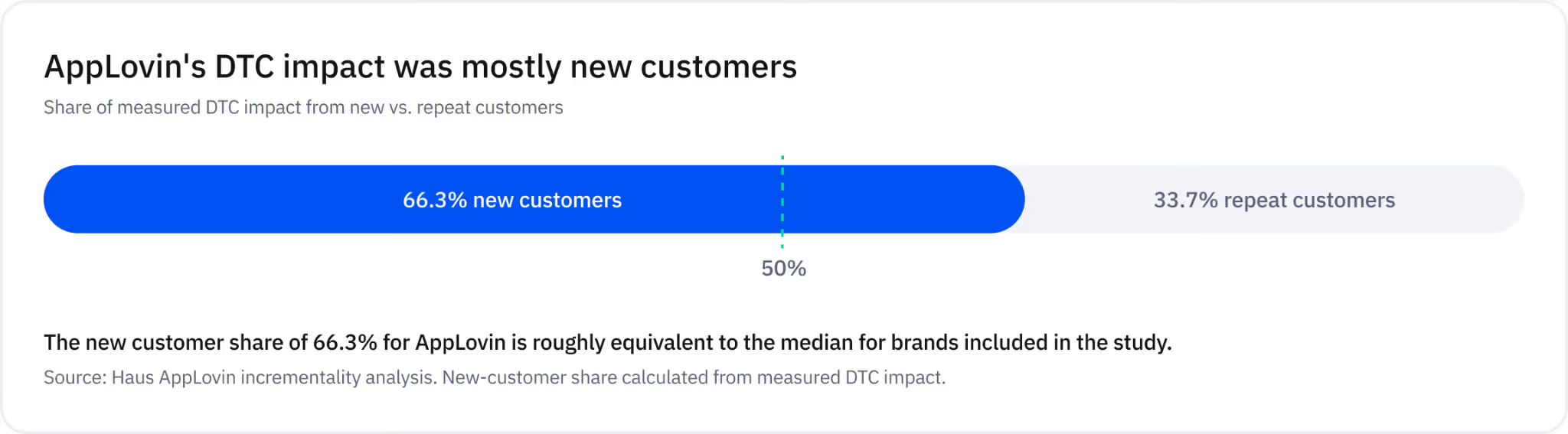
AppLovin has also started giving advertisers more control over customer-acquisition objectives, including Prospecting Campaigns that optimize toward new purchasers rather than treating new and returning customers the same.

This does not mean every AppLovin dollar is a new-customer dollar, or that brands should ignore customer quality, LTV or contribution margin. But it does support the case that AppLovin can be evaluated as a real acquisition channel, not just a short-term conversion tactic.

Does AppLovin's early signal hold at scale?

The most important forward-looking finding is that AppLovin’s performance has evolved as the channel has matured. 

To measure this without being misled by seasonality, we held every AppLovin test to a consistent bar: Did it beat the median efficiency across all tests a brand ran in the same quarter? In other words, did AppLovin outperform the typical test happening at the same time?

Across all AppLovin tests, 64% cleared that bar. But the trajectory matters more than the average. Through 2025, AppLovin beat the typical test a clear majority of the time – between 63% and 85% each quarter. In 2026, that has settled closer to a coin flip: 53% in Q1 and 50% in Q2.
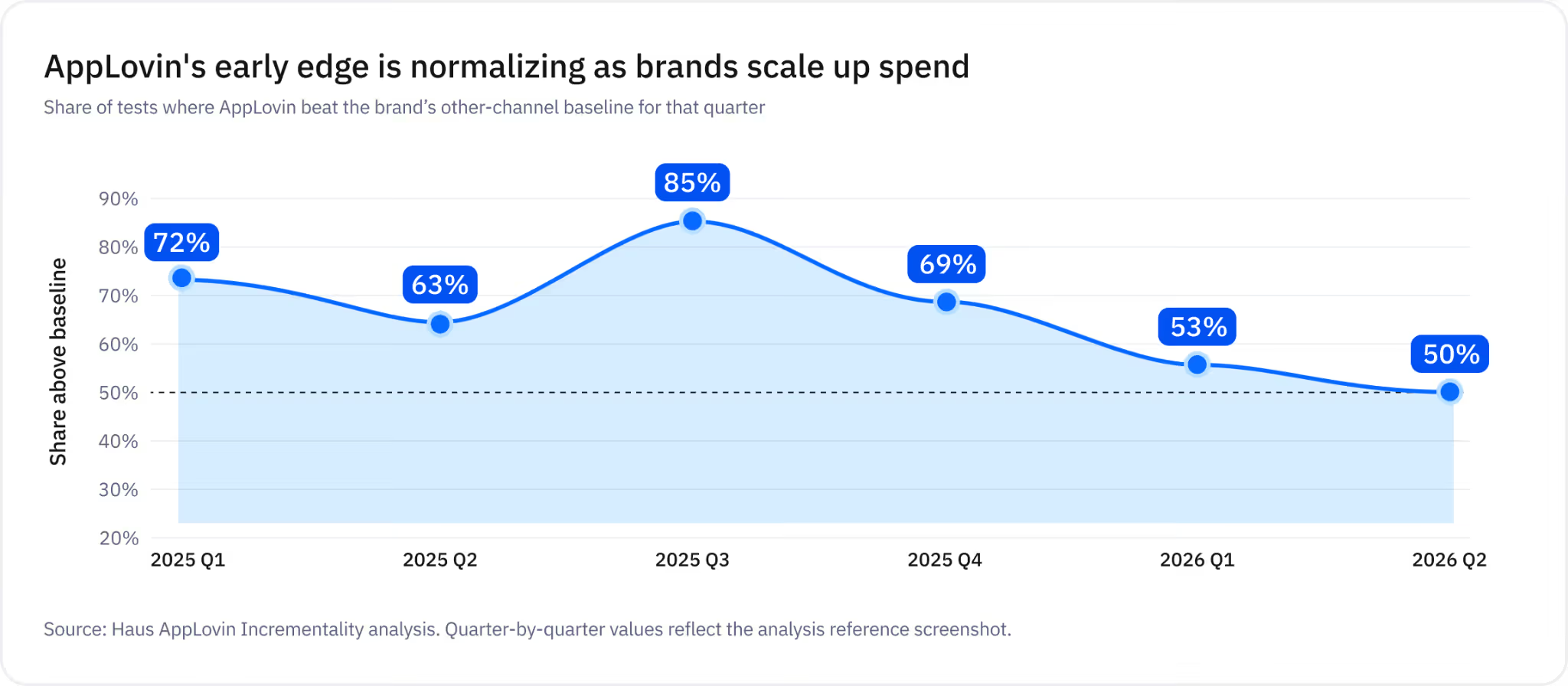
It would be easy to incorrectly overstate this as “AppLovin is getting worse.” That is too simplistic.

A more accurate read is that AppLovin is maturing out of its early-adopter phase. Looking only at each brand's first AppLovin test, the channel still performs well: First-time tests beat the typical result 53% of the time so far through 2026, an excellent hit-rate for a new channel. What has changed is what happens at scale: As brands run repeat tests and push more budget through the channel, results converge toward their median. AppLovin is no longer a near-automatic win on every test; it is a channel businesses have to optimize to keep hitting efficiency targets as they grow.

This is exactly what you would expect from an early, evolving channel. The first wave of adopters may have had cleaner access to underpriced inventory. As more DTC brands enter the auction, performance normalizes: CPMs rise, creative fatigue shows up faster, and the best early pockets of opportunity get harder to find. The mix of advertisers testing the channel has likely shifted as well.

Critically, brands aren’t walking away; they’re leaning in. Brands that have tested AppLovin since January 2026 have increased investment by over 50% relative to a ~20% median increase for brands who haven't run a test since then.

Among brands active on AppLovin and connected to Haus via API, the median brand's share of digital budget has climbed steadily through 2026, from under 5% in January to over 8% in May, holding there into June. Brands that began testing in the Q4-to-Q1 wave have kept growing their commitment as they have found their footing. Continuous testing is turning into continuous budget gains. 

That combination is the real story. Efficiency has come back to Earth from its 2025 highs, but brands are giving AppLovin more budget, not less. The channel is maturing from "does this work?" to "how far can this scale?"

Those are different questions and they require different tests. Performance varies over time for a variety of reasons – as you’ve heard us say before: What works for one business may not work for another, and brands should test for themselves.

If AppLovin is under 5% of your spend, you should still be validating whether it is worth continuing to invest in. As it approaches 10% or more, the question becomes marginal efficiency: What happens as spend increases, where does the response curve start to bend, and how often do we need to retest to keep our read fresh?

For most brands, AppLovin has earned a place in the testing roadmap, but not a blank check. The channel is promising enough to scale into, but volatile enough to require consistent re-evaluation as you go.

How brands can use this AppLovin marketing measurement data

It’s tempting to take insights like these and assume they will apply cleanly to your business, but they might not – every brand has a different media mix, creative strategy, product category, sales channel mix and level of existing demand.

With that obligatory disclaimer out of the way, here are some Haus-approved next steps:

  1. If you are a DTC-heavy brand looking to diversify beyond Meta and Google, AppLovin is worth testing. The DTC efficiency signal is strong enough that the channel should be on the shortlist and, due to the nature of the channel, you won’t have to wait long for a read on whether it’s working. 
  2. If you are omnichannel, measure AppLovin across all meaningful sales channels, but do not assume the halo effect will look like YouTube, CTV or other broader-reach channels. The data suggests AppLovin’s relative strength is dot-com impact.
  3. If AppLovin is already working, do not just scale indefinitely. Run spend-level tests to understand whether you are still on the efficient part of the curve or whether marginal dollars are getting more expensive.
  4. If results have softened recently, don't write off the channel immediately. Investigate CPMs, creative fatigue, audience saturation, campaign setup and auction competition. Some volatility should be expected in an early channel.
  5. Use post-treatment windows appropriately. AppLovin may not require the same long-tail patience as YouTube or CTV, but validating delayed effects still matters, especially for higher-consideration products.

So, does AppLovin perform?

Based on the data we analyzed, yes – especially for DTC brands looking for efficient, fast-moving acquisition beyond their core platforms.

But the more useful answer is the one AppLovin forces marketers to wrestle with: Not every good channel is good for the same reason. YouTube can be valuable because it is underreported, delayed and full-funnel. AppLovin appears valuable for almost the opposite reason: It is more immediate, more DTC-focused and often strong enough to rank near the top of the tested channel mix.

That is what makes it interesting.

The channel is not a magic replacement for Meta, Google or broader upper-funnel investment. It is also not just hype. It is a real, early and still-evolving channel that seems to have found a meaningful role for DTC advertisers.

The brands that get the most out of it will probably not be the ones that decide AppLovin is either a gold mine or a mirage. They will be the ones that treat it like what it is: A promising new performance channel, with enough signal to test seriously and enough volatility to keep testing as they scale.

That may be less satisfying than a universal verdict, but it will lead to smarter budget decisions. 

Subscribe to our newsletter

Article Authors

Tyler Horner

Tyler is Head of Solutions Consulting at Haus. With a decade of experience in marketing, he has spoken at The Lead Innovation Summit and Google’s Rethink ROI, and has authored numerous reports on marketing measurement.

Is AppLovin More Than a Hype Channel?

From the Lab
Jun 18, 2026

AppLovin is proving it can drive efficient DTC growth — now the question is how durable that performance is as the channel matures.

Are You Ready for An MMM?

Education
Jun 17, 2026

You're likely ready for an MMM when you’re no longer relying on just one or two channels and instead have activated a mix of channels. Let's dig deeper into what that looks like.

Can An AI Agent Make Budget Decisions You’d Bet Your Business On?

Marketers have long made billion-dollar budget calls on incomplete data. Architect is built to change that.

Why Enterprise Marketing Teams Stay Stuck on Bad Data (And How the Good Ones Get Out)

Education
Jun 2, 2026

Most enterprise teams know their marketing data isn't good enough. Haus Enterprise Measurement Strategist Kevin Keeley knows a thing or two about where the best ones start.

How to Turn Your MMM Into A Decision Engine, with Haus’ Hannah Perez

Inside Haus
Jun 1, 2026

For many enterprise businesses, their traditional MMM is packed with data but not actionable. Here's how Haus' Hannah Perez helps them operationalize MMM and experiments.

What is an enterprise incrementality platform?

Education
May 28, 2026

Every marketing team is running the same race: spend is growing, channels are multiplying, and the finance team wants to know whether any of it is actually working.

Choosing a marketing measurement platform for media and entertainment

Education
May 25, 2026

Media and entertainment companies don't have a measurement problem — they have several, stacked on top of each other in ways that make standard measurement tools look inadequate before you've even started.

AI marketing measurement: What do you need in your stack?

Education
May 24, 2026

Most marketing teams are spending money on measurement. The harder question is whether they're measuring the right things, with the right tools, in a way that actually leads to better decisions.

What is causal marketing?

Education
May 20, 2026

Incrementality is the marketing term for causality. An incremental conversion is one that resulted specifically from ad exposure, meaning it wouldn't have happened without the marketing.

Meta is changing its attribution settings. Here’s what you need to know.

Education
May 19, 2026

Meta is overhauling its attribution settings, including a new Incremental Attribution option. Here's what's changing and how to test what works for your brand.

Diversifying The Right Way: A Framework for Calculating the Marginal Efficiency of Your Marketing Channels

Education
May 12, 2026

An effective channel diversification strategy starts with grounding your thinking in marginal efficiency — not average efficiency. Here's how to do that.

Three Lessons Marketers Can Learn From a Failing Football Club

Education
Apr 27, 2026

What Tottenham’s collapse reveals about the right — and wrong — way to use advanced analytics.

Is Your Marketing ROI Real? A Brief History of Scanners and Sales

Education
Apr 13, 2026

When brands cut prospecting to chase ROAS, they stop replenishing future demand – and history illustrates what happens next.

Meta’s Attribution Overhaul: What Marketers Should Do Next

Industry News
Apr 7, 2026

Meta’s attribution changes could be affecting more than your reporting. Here's why you should retest your setup and how to use lift tests to settle the debate.

How Haus’ Tom O’Bara helps billion-dollar enterprises with their biggest marketing investment decisions

Inside Haus
Mar 31, 2026

Learn how Haus’ Tom O’Bara helps global brands and studios run impactful incrementality tests and answer their hardest measurement questions.

How to Run Geo Experiments During Sporting Events

Education
Mar 16, 2026

We unpack how Haus uses covariate stratification to help enterprise streaming platforms, broadcasters, and sportsbooks accurately measure the impact of ads run during live sports.

How long should you run an incrementality test for?

Education
Mar 10, 2026

We offer heuristics for determining test duration based on data from thousands of Haus tests and advice from Haus Measurement Strategists.

The Best Incrementality Testing Tools: How to Choose

Education
Mar 9, 2026

Whether you’re actively evaluating incrementality platforms or simply curious to learn more, consider this checklist your first stop.

How Haus Scales Causal Marketing Measurement Without Human Bias

From the Lab
Feb 24, 2026

How automating hundreds of causal models a week – and grading them with a blind exam – yields better outcomes for businesses.

How to Tie a Super Bowl Ad to Business Outcomes

Education
Feb 4, 2026

The Haus playbook for measuring tentpole brand campaigns

From Guesswork to Causal Truth: Measurement Lifer Feliks Malts’ Best Practices for Incrementality Testing

Inside Haus
Jan 28, 2026

Haus’ Feliks Malts has partnered with hundreds of teams on their incrementality testing programs. Here's how he ensures they're set up to drive real business impact.

Causal Intelligence, Explained: How AI Powers Incrementality Testing at Haus

From the Lab
Jan 8, 2026

Haus is built on AI and machine learning that strengthens the speed, accuracy, and reliability of incrementality tests.

MTA vs. MMM: Choosing Between Multi-Touch Attribution and Marketing Mix Modeling

Education
Dec 26, 2025

Let's unpack the differences between multi-touch attribution (MTA) and marketing mix modeling (MMM) and when each approach comes in handy for marketers.

Measuring Big Brand Moments With Time Tests

Haus Announcements
Dec 15, 2025

Now live in the Haus app, Time Tests estimate the incremental impact of a significant change to your business when test and control groups aren’t feasible.

The Cyber Week Incrementality Report: How CTV, YouTube, and Paid Social Drive ROI

From the Lab
Dec 11, 2025

We analyzed over a hundred incrementality tests before, during, and after BFCM 2025 and uncovered dramatic delayed conversion effects.

MMM Software: What Should You Look For?

Education
Dec 5, 2025

We discuss some of the key questions to ask a potential MMM provider — and the importance of prioritizing causality.

The TikTok Report

From the Lab
Dec 4, 2025

Can TikTok scale? How much omnichannel impact does TikTok have? Haus’ analyses of hundreds of TikTok incrementality tests answers these questions and more.

Causal Intelligence: How AI Works in Haus

From the Lab
Nov 21, 2025

Haus' AI-driven platform unleashes scientific rigor, reduces manual errors, and makes complex analytics accessible and actionable for every marketer.

Why Identification Matters: Changing How We Think About MMM

From the Lab
Nov 11, 2025

Identification is all about teasing out real causal relationships between tactics and outcomes — and it's the backbone of Haus’ Causal MMM.

How are incrementality experiments different from A/B experiments?

Education
Nov 5, 2025

Use A/B testing to optimize and incrementality testing to prove impact. Dive into differences, use cases, and how to pick the right test.

How Traditional Marketing Mix Modeling (MMM) Works in 2025 — and Why It’s Evolving

Education
Oct 31, 2025

Traditional marketing mix modeling (MMM) often relies on linear regression to illustrate correlation, not causation — but that's changing.

“It Felt Like A Civic Duty”: Why MMM Specialist Arthur Anglade Joined Haus

Inside Haus
Oct 22, 2025

Haus Principal Measurement Strategy Specialist Arthur Anglade has seen a lot of MMMs in his day. He sits down to explain why Causal MMM is different.

Marketing Measurement: The Fundamentals

Education
Oct 19, 2025

Learn the fundamentals of marketing measurement — from ROAS and MMM to incrementality testing — and discover how to measure true campaign impact.

Introducing Causal MMM

Haus Announcements
Oct 16, 2025

Meet Causal MMM: A marketing mix model that inspires trust, provides clarity, and drives smart marketing investments.

Incrementality: The Fundamentals

Education
Oct 9, 2025

Let's explore incrementality from every angle — what it is, what you can test, and what you need to get started.

World-Renowned Economist Susan Athey Joins Haus As Scientific Advisor

In this Q&A, John Bates Clark Medal-winning economist Susan Athey discusses why Haus is a company she just had to be a part of.

Marketing Attribution: The Fundamentals

Education
Oct 3, 2025

Discover what marketing attribution is, how it works, its pros and cons in 2025, and why incrementality testing provides a more precise measure of ROI.

When Is Branded Search Worth the Investment?

From the Lab
Sep 29, 2025

Our large-scale analysis of real-world, branded search incrementality experiments unpacks when branded search is most effective and how best to leverage it.

Can You Measure The Incrementality of Out-Of-Home (OOH) Marketing?

Education
Sep 26, 2025

Experiments reveal causality and establish the ground truth for cross-channel decision-making — even when it comes to OOH campaigns.

How Hoon Hong Uses Testing To Help Haus Customers Sharpen Their Storytelling

Inside Haus
Sep 23, 2025

Learn how Haus Measurement Strategist Hoon Hong uses incrementality tests to sharpen brands' storytelling and connect with key audiences.

Trust In, Trust Out: Why An MMM Built on Experiments Yields More Accurate Results

Education
Sep 17, 2025

Traditional MMM fails on bad data. Learn how Haus treats experiments as ground truth, taming noise and multicollinearity for trustworthy guidance.

What To Test in Q4: Advice from Haus Experts

From the Lab
Sep 16, 2025

Haus experts offer four useful, non-obvious incrementality tests that can prepare you for the busiest period of the marketing calendar.

Marketing Mix Modeling (MMM) Fundamentals: A Modern Guide

Education
Sep 15, 2025

Explore key concepts, benefits, and practical steps around MMMs — helping you measure and optimize marketing effectiveness.

Incrementality Experiments: A Comprehensive Guide

Education
Sep 4, 2025

We explore incrementality experiments from all angles — what they are, why they matter, and how they translate into business impact.

Optimizing Meta Ads: A Playbook for Brands

Education
Aug 15, 2025

From balancing the funnel to optimizing creative, our new guide has data-backed tips for improving performance on Meta.

Is Meta Incremental?

Education
Aug 13, 2025

We analyzed 640 Meta experiments on the Haus platform, revealing key insights into Meta's incrementality.

Geo Experiments: The Fundamentals

Education
Aug 7, 2025

Explore geo experiments from all angles — what they are, why they matter, and how you can use them to measure incremental impact.

GeoFences: Precise Geographic Control for Marketing Experiments

From the Lab
Aug 6, 2025

GeoFences enable you to exclude markets from your test that aren’t relevant to your business — helping you focus more deeply on the ones that are.

The Meta Report: Lessons from 640 Haus Incrementality Experiments

From the Lab
Jul 28, 2025

An exclusive Haus analysis show Meta is incremental in most cases — but is the platform's move toward automation improving incremental efficiency?

When Is It Time To Start Incrementality Testing?

Education
Jul 23, 2025

At our Open Haus AMA, a customer asked us: “How do you know when a brand is at the scale where investing in an incrementality tool makes sense?”

Why Incrementality? (And How to Start Testing)

Education
Jul 11, 2025

In our recent Open Haus AMA, we were asked why incrementality has become such a buzzword in marketing. Let's dive in.

Run Cleaner, More Accurate Holdout Tests with Haus Commuting Zones

From the Lab
Jul 9, 2025

Based on open source mobility data collected from mobile phone GPS data, Haus Commuting Zones minimize spillover and improve test accuracy.

What's The Difference Between Test-Calibrated MMM and Causal MMM?

Education
Jul 7, 2025

Sometimes used interchangeably, it’s worth clearly distinguishing between these two approaches and what they accomplish.

Incrementality Experiments: Best Practices and Mistakes to Avoid

Education
Jul 1, 2025

Incrementality testing requires proper design and intentional analysis. Let's walk through some best practices (and potential mistakes).

How An Applied Math Professor Turns Her Expertise Into Impact at Haus

Inside Haus
Jun 26, 2025

We talked to Senior Technical Fellow Vanja Dukic about her journey to Haus and how Haus lets academics translate their knowledge into action. 

Haus Launches Fixed Geo Tests to Measure Billboards, Regional, and OOH Activations

Haus Announcements
Jun 23, 2025

Haus’ exclusive Fixed Geo Tests enable marketers to rigorously measure campaigns that are traditionally difficult to quantify.

Incrementality vs. Attribution: What's The Difference?

Education
Jun 20, 2025

Dive into the key differences between attribution and incrementality — how each approach works, when they're useful, and key pros and cons.

Building An Incrementality Practice: A Practical Guide

Education
Jun 13, 2025

Building an incrementality practice is vital for any brand that's trying to improve decision making. Let's explore how to get started.

How Victoria Brandley Went from Early Haus Customer to Haus Measurement Strategist

Inside Haus
Jun 9, 2025

Measurement Strategist Victoria Brandley walks us through her full-circle journey to Haus and how she became an incrementality believer.

Assembling A Marketing Measurement Plan

Education
Jun 6, 2025

Let’s walk through how to build a marketing measurement plan that puts experimental data at the center.

What Brands Should Be Thinking About In Advance of Prime Day 2025

From the Lab
Jun 5, 2025

Our Measurement Strategists explain which tests can make a difference as you prep for Prime Day 2025.

Incrementality Testing vs. Traditional MMM: What's The Difference?

Education
May 30, 2025

Let's explore some of the differences between traditional media mix modeling and incrementality testing.

Optimizing Your Paid Media Mix in Economic Uncertainty: Your 5-Step Playbook

Education
May 26, 2025

When macroeconomic conditions shift, marketers should proactively partner with finance, understand how budgets may change, and test for efficiency.

Incrementality Testing: The Fundamentals

Education
May 22, 2025

Incrementality testing isolates true campaign impact — giving you clarity, confidence, and a case your CFO will love.

Marketing Measurement: What to Measure and Why

Education
May 5, 2025

This guide outlines the metrics, testing methods, and proven frameworks you can use to measure marketing effectiveness in 2025.

Why An Econometrics PhD Left Meta To Tackle Big Causal Questions at Haus

Inside Haus
May 2, 2025

Senior Applied Scientist Ittai Shacham walks us through life on the Haus Science team and the diverse expertise needed to build causal models.

What You’re Actually Measuring in a Platform A/B Test

Education
May 1, 2025

Platform creative tests may not meet the definition of a causal experiment, but they can be performance optimization tool within the bounds of the algorithm.

Beyond the Buzzwords: Why Transparency Matters in Incrementality Testing

From the Lab
Apr 29, 2025

Brands need to have complete information to make responsible decisions like their company depends on it.

Should I Build My Own MMM Software?

Education
Apr 11, 2025

Let's unpack the pros and cons of building your own in-house marketing mix model versus working with a dedicated measurement partner.

Why An Analytics Expert Left Agency Life to Become Haus' First Measurement Strategist

Inside Haus
Apr 10, 2025

Measurement Strategy Team Lead Alyssa Francis sat down with us to discuss how she pushes customers to challenge the testing status quo.

Understanding Incrementality Testing

Education
Apr 2, 2025

Fuzzy on some of the nuances around incrementality testing? This guide goes deep, unpacking detailed examples and step-by-step processes.

How to Know If An Incrementality Test Result Is ‘Good’ – And What to Do About It

Education
Mar 21, 2025

Plus: What to do when a test result is incremental but not profitable, and a framework for next steps after a test.

Why A Leading Economist From Amazon Came to Haus to Democratize Causal Inference

Inside Haus
Mar 19, 2025

We sit down with Principal Economist Phil Erickson to talk about Haus’ “unhealthy obsession” with productizing causal inference.

Haus x Crisp: Measure What Matters in CPG Marketing

Haus Announcements
Mar 13, 2025

When real-time retail data meets incrementality testing, CPG brands can finally measure what’s working and optimize ad spend with confidence.

Why Magic Spoon’s Former Head of Growth Embraces Incrementality at Haus

Inside Haus
Mar 10, 2025

In our first episode of Haus Spotlight, we speak to Measurement Strategist Chandler Dutton about the in-the-weeds approach Haus takes with customers.

Do YouTube Ads Perform? Lessons From 190 Incrementality Tests

From the Lab
Mar 6, 2025

An exclusive Haus analysis shows YouTube often delivers powerful new customer acquisition and retail halo effects that traditional metrics miss.

Getting Started with Causal MMM

Education
Feb 24, 2025

Causal MMM isn’t rooted in historical correlational data – it’s rooted in causal reality.

A First Look at Causal MMM

Haus Announcements
Feb 19, 2025

Causal MMM is a new product from Haus founded on incrementality experiments. Coming 2025.

Would You Bet Your Budget on That? The Case for Honest Marketing Measurement

From the Lab
Feb 14, 2025

Acknowledging uncertainty enables brands to make better, more profitable decisions.

Getting Started with Incrementality Testing

Education
Feb 7, 2025

As the customer journey grows more complex, incrementality testing helps you determine the true, causal impact of your marketing.

Matched Market Tests Don't Cut It: Why Haus Uses Synthetic Control in Incrementality Experiments

From the Lab
Jan 28, 2025

Haus’ synthetic control produces results that are 4x more precise than those produced by matched market tests.

Incrementality School, E6: How to Foster a Culture of Incrementality Experimentation

Education
Jan 16, 2025

Having the right measurement toolkit for your business is only meaningful insofar as your team’s ability to use that tool.

Geo-Level Data Now Available for Amazon Vendor Central Brands

Industry News
Jan 6, 2025

Vendor Central sellers – brands that sell *to* Amazon – can now use Haus to measure omnichannel incrementality.

2025: The Year of Privacy-Durable Marketing Measurement

From the Lab
Dec 28, 2024

Haus incrementality testing doesn’t rely on pixels, PII, or other data that may be vulnerable to privacy regulations.

Meta Shares New Conversion Restrictions for Health and Wellness Brands

Industry News
Nov 25, 2024

Developing story: Starting in January 2025, some health and wellness brands may not be able to measure lower-funnel conversion events on Meta.

Incrementality School, E5: Randomized Control Experiments, Conversion Lift Testing, and Natural Experiments

Education
Nov 21, 2024

Sure, the title's a mouthful – but attributing changes in data (ex: ‘my KPI went up') to certain factors (ex: ‘we increased ad spend’) is hard to do well.

Incrementality School, E4: Who Needs Incrementality Testing?

Education
Nov 14, 2024

As brands' marketing strategies grow in complexity, incrementality testing becomes increasingly consequential.

Incrementality School, E3: How Do Brands Measure Incrementality?

Education
Nov 7, 2024

Traditional MTAs and MMMs won't measure incrementality – but geo experiments reveal clear cause, effect, and value.

Incrementality School, E2: What Can You Incrementality Test?

Education
Oct 31, 2024

Haus’ Customer Marketing Lead Maddie Dault and Success Team Lead Nick Doren dive into what you can incrementality test – and why now's the time.

What is Incrementality? (Incrementality School, Episode 1)

Education
Oct 24, 2024

To kick off our new Incrementality School series, three Haus incrementality experts weigh in describing a very fundamental concept.

Inside the Offsite: Why Haus?

Inside Haus
Oct 17, 2024

At this year's offsite, we dove into why – of all the companies, options, and career paths out there – our growing team chose Haus.

Haus Named One of LinkedIn's Top Startups

Inside Haus
Sep 25, 2024

A note from Zach Epstein, Haus CEO.

Google Announces Plan to Migrate Video Action Campaigns to Demand Gen

Industry News
Sep 6, 2024

The news leaves advertisers swimming in uncertainty — which is why it’s so important to test before the change.

Conversion Lag Insights: How Haus Tests Can Help Optimize Q4 Budgets

From the Lab
Sep 5, 2024

Post-treatment windows offer a unique glimpse into the lingering impacts of advertising campaigns after they’ve concluded.

PMAX Experiments Revealed: Including vs. Excluding Branded Search Terms

From the Lab
Aug 20, 2024

We analyzed experiments from leading brands to understand the incremental impacts of including vs. excluding branded terms in PMAX campaigns.

CommerceNext Session Recap: How Newton Baby Uses Incrementality Experiments to Maximize ROI

From the Lab
Aug 9, 2024

“We ran the test of cutting spend pretty significantly and it turns out a lot of that spend was not incremental,” says Aaron Zagha, Newton Baby CMO.

Introducing Causal Attribution: Your New Daily Incrementality Solution

Causal Attribution syncs your ad platform data with your experiment results to provide a daily read on which channels drive growth.

Haus Announces $20M Raise Led by 01 Advisors

Haus Announcements
Jul 30, 2024

With this additional support, Haus is well-positioned to deepen our causal inference capabilities and announce a new product: Causal Attribution.

3 Ways to Perfect Your Prime Day Marketing Strategy

Education
Jun 26, 2024

Think Amazon ads are the only effective marketing channel for Prime Day? Think again.

Maximize Your Q4 Growth With 4 High-Impact, Low-Risk Tests

Education
Nov 8, 2023

Not testing during your busy season may be costing you more than you think.

Why Maturing Direct to Consumer Brands Need to Run Incrementality Tests

Education
Sep 15, 2023

The media strategy that gets DTC brands from zero to one does not get them from one to ten.

5 Signs It’s Time to Invest in Incrementality

Education
Aug 9, 2023

5 common signs that indicate it is definitely time to start investing in incrementality.

$17M Series A, Led by Insight Partners

Haus raises $17M Series A led by Insight Partners to build the future of growth intelligence.

Why Meta's “Engaged Views” Is a Distraction, Not a Solution

Industry News
Jul 25, 2023

While additional data can be useful, we must question whether this new rollout is truly a solution or merely another diversion.

Why You Need a 3rd Party Incrementality Partner

Education
Jul 6, 2023

Are you stuck wondering if you should be using 3rd party incrementality studies, ad platform lift studies, or trying to design your own? Find out here.

iOS 17 Feels Like iOS 14 All Over Again. What It Means for Growth Marketing…And Does It Matter Anymore?

Industry News
Jun 12, 2023

A single press release vaguely confirmed that Apple will continue its assault on user level attribution. Here, I unpack what I think it means for growth marketing.