Measuring Impact from Day One: How to Measure Incrementality Without Historical Data
See how Haus ColdStart uses comparable KPIs to test the incrementality of new products, markets, and channels that lack historical data.

Aug 7, 2026

Enterprise marketers are always introducing something new. Maybe your brand just launched a new hero SKU or product line. Or expanded into a new market. Or landed a major new retail partnership. Or acquired a business that changed what you're even supposed to be measuring.
Regardless of the scenario, leadership wants to know if your media strategy for this key initiative is working. And they want to know as soon as possible.
To measure its impact, you need at least nine months of historical data for the metric you want to measure. In any of the situations above, historical data will be a problem. When you're measuring something genuinely new – a new product, a new market, a new retail channel, or a new line of business – you don’t have any historical data to refer to.
This is critical for incrementality experiments because you need a reliable baseline to create an estimate of what would have happened without the campaign (a counterfactual). Which means incrementality testing isn't possible at all. Not being able to test and prove new tactics blocks key learnings and slows decision-making, which ensures the risk you're taking on something new actually pays off.
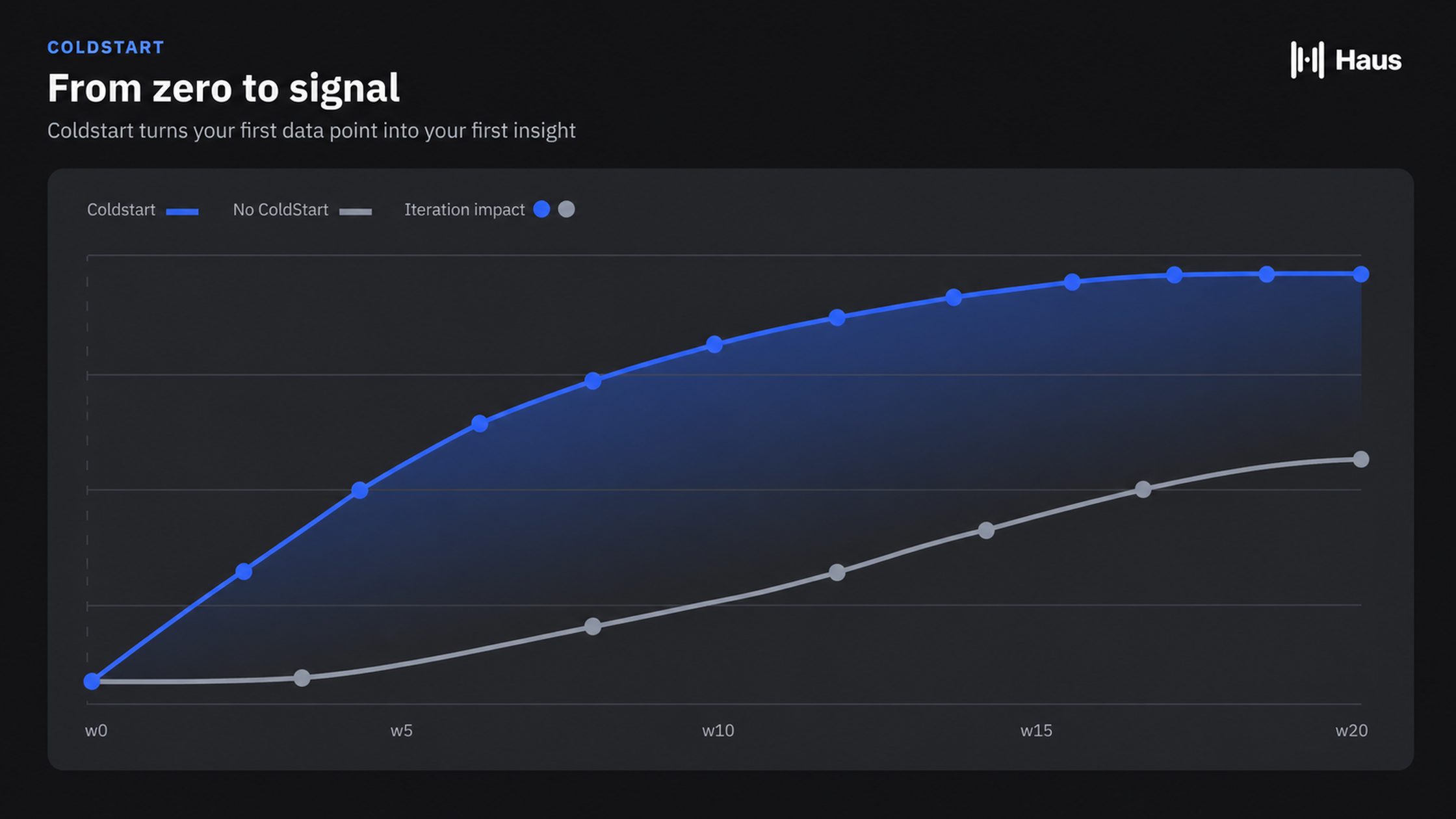
ColdStart is Haus' answer to that gap. It's the same causal geo-testing as Haus' GeoLift – same design principles, same results view – but it’s built to activate automatically when the KPI itself is too new to have a track record.
How it works: borrowing history from somewhere else
While the science behind our ColdStart methodology is complex, the core idea behind it is simple: If your KPI doesn't have historical data, borrow historical context from KPIs that do.
In a standard geo experiment, pre-period data tells Haus how a KPI naturally moves across regions before any intervention: which regions naturally drive revenue, which run quiet, and how much they swing on their own. That pattern enables Haus to estimate what the noise between treatment vs. control groups would be, which in turn determines how much of the country needs to be held out to detect lift.
When that history doesn't exist, ColdStart substitutes comparable KPIs – related metrics with an established track record – for the primary KPI. These stand in for what a new KPI can't yet provide: the missing pre-period baseline, the regional pattern that KPI would likely have followed, and the noise estimate needed to power the test correctly.
This means running a series of placebo tests on this existing comparable KPI. But because this is a placebo test and nothing has fundamentally changed, the lift should be zero. If these tests register a lot of lift, we know they are false positives, and the data is noisy. That noise level then helps us determine the holdout size for your real test.
Strong comparable KPIs are ones that behave similarly to your target KPI across geos, in both trend and level. For a new product launch, that might be sales from prior comparable releases. For a new venture, it might be the closest analogous channel at the parent company. For a market expansion, it's often the same brand's performance in a market it already knows well. You don't have to identify comparable KPIs on your own – a Haus Measurement Strategist will work with you to select a comparable KPI during setup, then match that against your target KPI before the test launches.
Once the campaign is live, Haus switches to your real KPI for the readout. The comparable KPI's sole purpose was to get the test properly designed before that data existed.
How brands are using comparable KPIs today
Haus initially developed this methodology to support marketing measurement for film studios, since every title is a new KPI and a film's theatrical window is too short to wait nine months for data. So, for example, if a studio wants to run an experiment on the impact of Meta ads on ticket sales for their new horror film release, we will look at other films in the same genre with similar budgets released in the past few years. They’ll upload ticket sales from those films as comparable KPIs, and use them as the data to help draw the test and control regions, make it testable, and attach the impact that they’re having on sales.
But this same challenge shows up wherever a business makes an important bet without enough historical data. Here are five use cases for ColdStart, and how brands can think about comparable KPIs.
New product or SKU
A new product launch is the most intuitive ColdStart use case. The KPI that matters most, such as unit sales for a new soda flavor or subscriptions to a new premium plan, simply does not have enough history to support a standard geo experiment.
M&A or launching an entirely new business
When a company introduces a whole new line of business or acquires another company, the KPI often changes more dramatically than it does with a product launch. Think of a retailer adding a membership offering or a CPG brand acquiring a business complementary to its product portfolio. In these cases, the new KPI may be structurally different from the company’s historical core KPI.
New retail channel or partnership
A brand expanding into Amazon, Target, Walmart, DoorDash, or another strategic retail partnership often needs measurement immediately, but that new channel has no performance history of its own yet. Waiting for the channel to mature defeats the point, because the launch period is when the biggest spend and distribution decisions are being made.
New market expansion
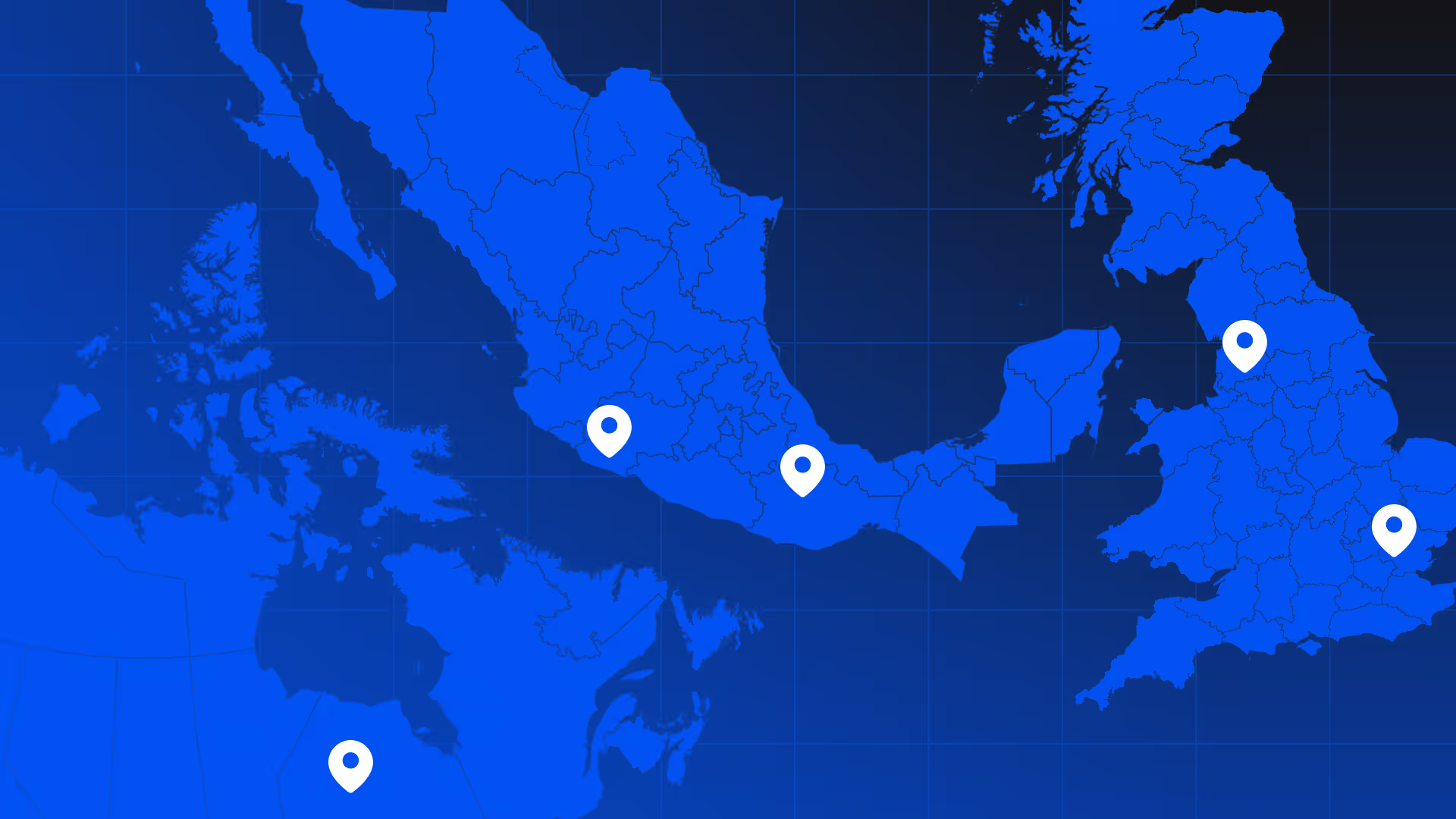
Geographic expansion into new markets creates a classic use case for ColdStart because there have never been sales in that region. A US brand entering Canada, launching in the UK, or moving into a new region may have strong global history but little market-specific data for the KPI it wants to measure.
High seasonality or short annual windows
Not every cold-start problem comes from launching something brand new. Sometimes the issue is that the business only has a small, unreliable measurement window each year. A practical example would be a tax-prep company that only ramps media ahead of filing season. If the team wants to measure this year’s paid social push in January through April, last year’s data may not be enough on its own because the business goes quiet for much of the rest of the calendar and campaign conditions can change a lot from season to season. The KPI is not new, but the active window is so short and irregular that the brand still needs a more thoughtful experiment design.
Getting Started
ColdStart provides an actionable alternative for measuring anything genuinely new, without waiting months for data that doesn't yet exist, relying on correlational insights, or trusting a single platform's self-reported lift.
If you're sitting on a new launch, market, channel, or business with more questions than data, that's exactly the situation ColdStart was built for.
.png)
.png)


.png)
.png)
.png)
.avif)


.avif)
.avif)

.avif)
.avif)
.avif)
.avif)
.avif)


.avif)


.avif)


.avif)
.avif)
.avif)
.avif)
.png)
.png)
.avif)


.avif)
.avif)
.avif)
.avif)
.avif)
.avif)

.avif)

.avif)

.avif)

.avif)
.avif)
.avif)
.avif)
.avif)


.avif)
.avif)
.avif)
.avif)

.avif)
.avif)
.avif)

.avif)

.avif)
.avif)
.avif)
.avif)

.avif)


.avif)
.avif)



.avif)
.avif)
.avif)

.avif)
.avif)
.avif)
.avif)
.avif)
.avif)



.png)
.avif)
.png)
.avif)