Are You Ready for An MMM?
You're likely ready for an MMM when you’re no longer relying on just one or two channels and instead have activated a mix of channels. Let's dig deeper into what that looks like.
Jun 17, 2026

As your marketing program matures, the questions get more complex to answer. Your executive team wants to know which channels are efficient and how the budget should be split, but experiments can only answer part of that. You can feel the gap, but it's tough to know how and when to close it.
Haus has worked with a long list of brands through this exact evolution, and a few patterns make the decision clearer. Here's how to tell if you're ready.
A measurement stack matures in stages
Most strong measurement programs grow in a sequence. Teams usually start with incrementality experiments because a clean test gives you causal truth about a channel: run it, hold out a comparable group, and measure the lift. That foundation answers whether a channel actually drives results.
Experiments are great at measuring the incrementality of geosegmentable channels, the ones you can turn up or down by region. But at some point, you want to understand how all of your channels are working together. That's where marketing mix modeling (MMM) comes in. An MMM is a statistical model that quantifies the relationship between your marketing efforts and business outcomes like sales or revenue. It extends the read you get from experiments across the whole mix and turns it into channel contribution, marginal returns, and "what-if" budget scenarios you can plan against.
An MMM isn't a do-over of your experimentation program. It's the next step. Experiments are telling you which individual ingredients you need, and MMM is the recipe that tells you how to put those ingredients together.
Three signs you're ready for an MMM
Across the brands we've watched make this move, three signals tend to show up together. If these sound familiar, you might be ready to add an MMM.
You're managing a cross-channel budget
Many brands start with one or two core channels. As they grow, the channel mix expands as well. Once this happens, a single-channel read stops being enough to make decisions. You don't just want to know whether each channel is incremental on its own. You want to know how they stack up against each other in a cross-channel view, so you can compare them on the same terms.
That's exactly what an MMM is built for. It teases apart each channel's contribution and estimates marginal returns and supports budget planning so you can see how channels stack up against each other. You can ask what happens if you shift spend from one channel into another before you move real money. The more channels you're already testing, the more signal an MMM has to work with, and the more leverage you get from the model.
You need visibility into channels you can't geo-segment
Incrementality experiments are powerful for geo-segmentable channels. The channels you can turn up or down by region to isolate the effect. However, Linear TV, podcast, influencer, and other broad-reach channels don't lend themselves to that kind of controlled test. For a long time, that meant brands had to either guess at the contribution of these channels or leave them out of their measurement framework altogether.
This is one of the core reasons businesses add an MMM. When your media mix includes channels that can't be geo-tested, you need a model that can eliminate blind spots and give you a credible read on all channel performance.
This is where the causal foundation of Haus' MMM makes a meaningful difference. Because the model is anchored to experiment results you already trust, its estimates for non-testable channels stay tethered to real-world signal rather than relying on historical correlation. This approach makes the results more defensible, which matters when you're deciding whether to move budget between Linear TV and paid social, or weighing a podcast sponsorship against incremental search spend. If you're relying on a tool to guide your decision-making, you need an MMM that can show its work.
You’ve built a culture of acting on experiment results
Many teams run experiments, but not all have changed how they actually work because of them. If your team has adapted its workflows and decisions around experiment results, you're in a prime position to expand your stack with an MMM.
This matters more than it might seem. Haus’ Hannah Perez sums up the importance of knowing what you want the outcome of an MMM to be: “Understand your goals, mobilize the necessary tooling and resourcing to meet those goals, then deliver on the ultimate goal: driving real business transformation.”
Haus' Causal MMM is grounded in your experiment results, which means trusting and acting on those results is what lets you evolve the framework to include an MMM. If experiments are still something you run and then quietly ignore, an MMM built on top of them won't get the trust it needs. A model that's calibrated to the experiments you already trust is only as useful as that trust.
The questions that signal it's time
Sometimes the clearest sign isn't a metric. It's the questions your team starts asking. When people in your meetings begin saying things like:
- “If we scale up on channels, which can we scale down with the least risk?”
- “Recent testing is showing decreasing efficiency on our top channel. Where should we reallocate that budget?”
- “We have a spike in sales throughout the holidays, but the price of buys hurt our efficiency. How can we shift budgets over time to increase overall efficiency?”
That's a strong cue that it's time to explore adding an MMM to your stack. These are cross-channel, budget-level questions, and they're hard to answer with single-channel reports alone. They're the kind of trade-off questions an MMM is designed to inform.
How an MMM should fit your existing stack
An MMM works best when it and your experiments are telling the same story. When they're not, the conflict is a distraction from taking action.
In practice, that means your experiments show a channel isn't driving incremental results, but your MMM recommends you scale. Now, instead of using your measurement to make a clear budget call, your team is stuck determining which tool to trust. The measurement that was supposed to be a growth lever causes a swirl and delays decision-making.
This is why it matters how an MMM is built. Traditional MMMs lean on historical correlation, which means their recommendations can diverge from what your tests are actually showing. When that divergence happens, the picture of what’s working and what’s not is muddied.
A causally grounded MMM is designed to avoid this. By treating your experiment results as ground truth rather than a secondary input, the model stays anchored to what your tests showed. When the MMM and your experiments agree, you can move fast. When they surface a tension, it's a meaningful signal worth investigating.
That's why, as you evaluate options, it's worth asking whether a model is built on high-quality experiments and whether its recommendations line up with your experiment results. If the model says to keep pouring money into a channel your tests show isn't incremental, you’ve now got another problem to solve instead of the answers you were looking for. A causality-driven MMM treats experiments as ground truth, which is a meaningfully different foundation than bolting a few tests on after the fact.
Conclusion
Deciding when to add an MMM doesn't have to be guesswork. If you're spending across a range of channels, your team already acts on what experiments tell you, and you’re starting to question where your next dollar will make the most impact, the signals are pointing the same direction. An MMM gives you the cross-channel view to allocate budget with more confidence and less waste.
The piece that ties it together is calibration. An MMM should build on the experiment results you've already learned to trust, not ask you to trust a black box instead. That's the idea behind Haus' Causal MMM: take the experiments you're already running and turn them into a model you can plan a budget around.
Frequently asked questions
What is a marketing mix model (MMM)?
An MMM is a statistical model that quantifies the relationship between your marketing spend and business outcomes like sales or revenue. It teases apart how much each channel contributes, estimates marginal returns, and lets you run "what-if" scenarios before you move real budget.
When is a brand ready to add an MMM?
A few signals tend to show up together: you're spending across a range of channels, your team already acts on what experiments tell you, and you’re starting to question where your next dollar will make the most impact. When those are true, an MMM gives you a cross-channel view that single-channel reports can't.
Does an MMM replace incrementality experiments?
No. An MMM is the next layer on top of experiments, not a substitute. Experiments give you a precise causal read on the channels you can test, and an MMM extends that read across your whole media mix.
What's the difference between a traditional MMM and Causal MMM?
Traditional MMMs lean on historical correlation, so their answers can drift as conditions change. Causal MMM treats experiments as ground truth instead, so the model stays anchored to what your tests actually showed, and the signal gets sharper as more experiments are run.
How do I evaluate an MMM provider?
Ask whether the model is genuinely built on high-quality experiments and whether its recommendations line up with your experiment results. If a model keeps recommending spend in a channel your tests show isn't incremental, that's a trust problem worth catching before you buy.
What kinds of questions can an MMM help answer?
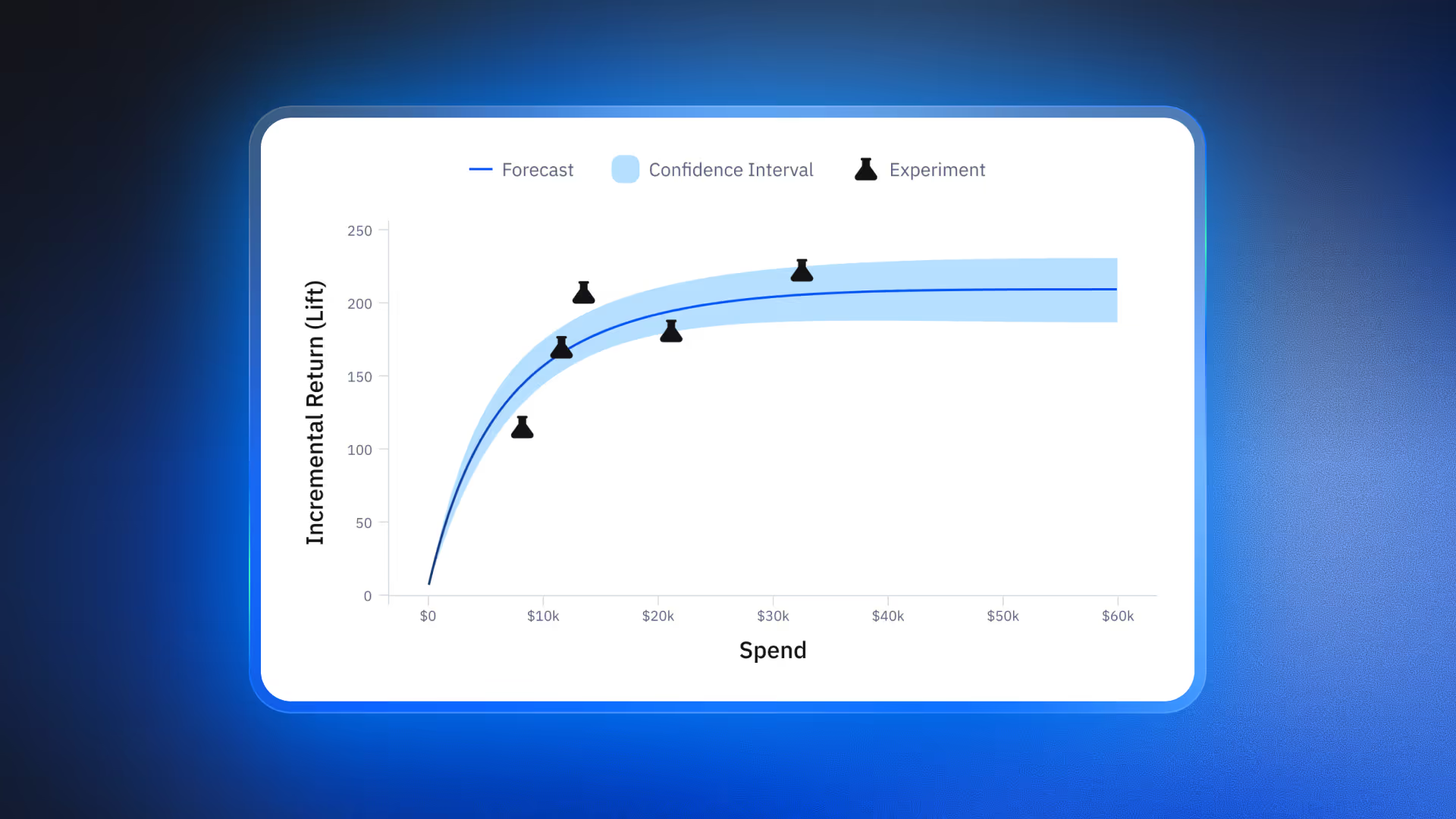
An MMM is built for the questions that can't be resolved by looking at channels in isolation. It answers whether a channel is working better than the alternatives and at what spend level. It models the relationship between spend and outcomes across your full portfolio as a curve, so you can see where you're under and over-invested. The output is a framework for deciding where the next dollar will work hardest.
Related reading
- MMM Software: What Should You Look For? — the five questions to ask a provider before you buy, and why experiment foundations matter.
- Trust In, Trust Out: Why An MMM Built on Experiments Yields More Accurate Results — how calibrating to experiments tames noise and builds a model you can trust.
- When Is It Time To Start Incrementality Testing? — a look at the scale and signals that mean a brand is ready for experimentation, the layer beneath an MMM.
.png)
.png)


.png)
.png)

.png)
.avif)


.avif)
.avif)

.avif)
.avif)

.avif)
.avif)
.avif)


.avif)


.avif)


.avif)
.avif)
.avif)
.avif)
.png)
.png)
.avif)


.avif)
.avif)
.avif)
.avif)
.avif)
.avif)

.avif)

.avif)

.avif)

.avif)
.avif)
.avif)
.avif)
.avif)


.avif)
.avif)

.avif)
.avif)

.avif)
.avif)
.avif)

.avif)

.avif)
.avif)
.avif)
.avif)

.avif)


.avif)
.avif)



.avif)
.avif)
.avif)

.avif)
.avif)
.avif)
.avif)
.avif)
.avif)




.png)
.avif)
.png)
.avif)