GeoLift to cMMM: Getting more from your incrementality practice
GeoLift answers whether a channel worked. Causal MMM answers what to spend on each channel.
Jun 30, 2026

You've built a solid incrementality practice. Your GeoLift experiments are running, your testing roadmap is taking shape, and you're starting to accumulate real answers about what's actually driving growth. That's a meaningful foundation that many marketing teams strive for but few achieve.
But if your measurement stops at individual test readouts, you're leaving value on the table. GeoLift can tell you whether a channel worked or whether this month's spend level outperformed last month's. It can't tell you how much to spend across all channels or how external factors like seasonality and macro shifts are affecting your business on their own.
That's where Causal MMM comes in. cMMM is the additional measurement layer that extends the value of your experiments. cMMM turns your experiment outputs into an optimization engine that helps you move from one-off testing to continuous budget optimization and a more resilient media mix.
What GeoLift answers well and what it doesn’t
GeoLift is built to answer precise, channel-level questions with scientific rigor. Did this channel drive incremental revenue? Was this spend level more effective than the one before it? Those are high-stakes questions, and geo experiments give you causal answers you can stand behind.
What GeoLift can't do on its own is synthesize those answers into a holistic view of your entire media mix. It won't tell you the optimal allocation across Meta, Google, TikTok, and everything else simultaneously. It won't quantify how a pricing change, a competitor launch, or a seasonal spike is affecting your P&L independent of your ad spend.
That gap isn't a flaw in geo testing. It's a scope question. Experiments isolate variables; marketing mix models connect them. And when the two work together, each makes the other more useful.
How cMMM turns experiment outputs into an optimization engine
Traditional marketing mix models often update quarterly at best, and sometimes only twice a year. As Haus Solutions Consultant Hannah Perez puts it, many enterprise teams end up with an MMM that's “more of an artifact than a decision-making tool.” The data is there, but the cadence doesn’tmatch how quickly budgets actually move today.
Causal MMM is different because it treats your experiment results as ground truth, not suggestions. Haus' approach starts with experiments and lets observational data fill in the gaps rather than the other way around. Traditional MMMs are built on noisy, multicollinear historical data. A BCG report found that 68% of companies don't consistently act on MMM results when allocating budget. When the underlying data isn't causal, that's not surprising.
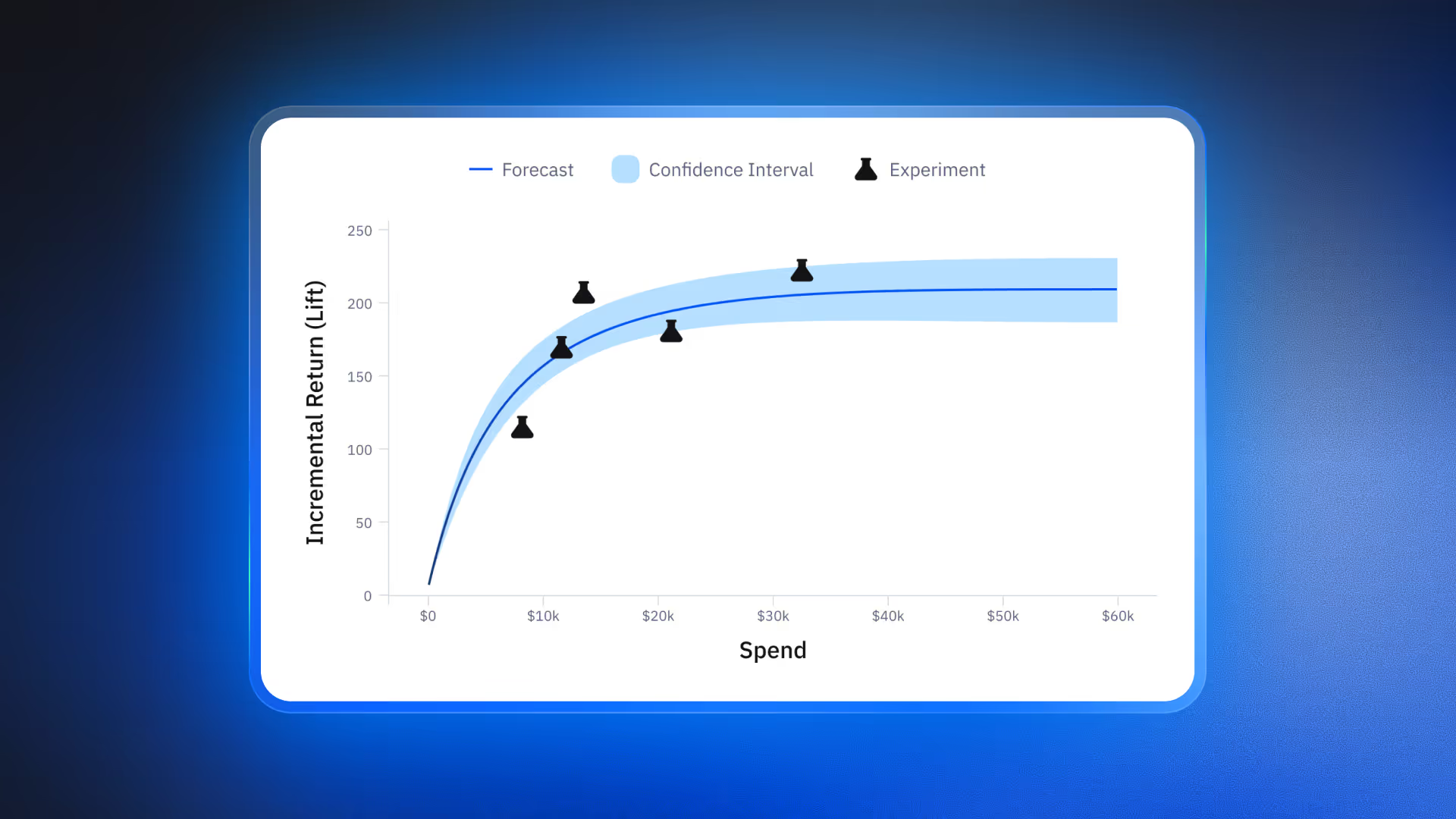
cMMM connects your GeoLift results into response curves that show incremental impact at different spend levels, across channels, and over time. Instead of waiting months for a model refresh, you get budget guidance that's anchored to the same incrementality tests you already trust. The result is a system that compounds: every new experiment makes the model sharper, and every model update gives you a clearer picture of where to test next.
What this looks like in practice
OluKai: Trusting the right model leads to the right decisions
OluKai's story is a clear example of why experiment-grounded modeling matters. Heading into Q4, their existing MMM vendor showed results that recommended prioritizing view-through-heavy channels like TikTok, Snap, and YouTube. But OluKai's Haus GeoLift experiments told a different story: TikTok and Snapchat were less incremental than Meta.
At first, they followed the legacy MMM guidance and shifted budget to those view-through channels and pulled back on Meta. CAC came in 20% higher than predicted. Leadership was concerned, and the forecasts weren't matching reality.
When OluKai turned to Haus’ cMMM, the picture changed. Because cMMM is powered by their causal experiments, not just historical correlations, it showed that Meta and Google were the most efficient drivers of incremental sales.
They reallocated approximately 50% of view-through channel spend into Meta and reduced total marketing spend by ~15%, right before their most important quarter. CAC dropped ~20%. Haus’ cMMM's order volume and CAC forecast matched actuals, and performance improvements held for several weeks, even at lower total spend.
As Ben Bolognini, VP of Ecommerce at OluKai, puts it: “When clear experimentation and directional measurement results disagree, incrementality should win.”
Sunday: Weekly reads for agile planning
Sunday's business moves fast. Consumer lawn care demand peaks on weekends, so the marketing team huddles every Monday to review performance and set the week's budget. Platform reporting wasn't enough, and traditional MMMs only delivered insights on a monthly cadence at best.
With cMMM, Sunday gets an up-to-date causal read every Monday morning with data from the week prior. Their response curves are built from a combination of GeoLift and Meta Conversion Lift studies. Haus anchors absolute incrementality with GeoLift where tests exist, while using Conversion Lift to extend coverage across spend ranges not captured by geo tests.
As advertising efficiency shifts over time, cMMM dynamically weights experiments so older or out-of-season tests remain representative of the current planning period. Channel owners make same-week budget and pacing adjustments based on a response curve grounded in real-world GeoLift testing. This is what gives them the confidence to scale. It's the operating rhythm behind why Sunday starts winning the week on Monday morning.
Building a more resilient media mix
Experiment learnings compound when they inform how you think about the full mix, not just individual channels. On a recent Open Haus episode, Measurement Strategist Dean Gordon walked through a framework for diversifying your media mix, emphasizing the distinction between average and marginal returns. A channel that looks efficient on average may be saturated at your current spend level. cMMM surfaces those saturation points through response curves, so diversification decisions are grounded in marginal efficiency — not platform-reported averages.
The same logic applies to operationalizing your model day to day. As Hannah Perez notes in how to turn your MMM into a decision engine, the destination has to be action. Understand your goals, build your incrementality practice, then connect experiment outputs to budget decisions at the cadence your business actually runs on.
For teams getting started with the cMMM layer, our guide on getting started with Causal MMM covers what to expect and how your existing GeoLift results feed in.
Conclusion
If you're already running GeoLift experiments through Haus, you've done the hard part: building a source of causal proof about your marketing performance. cMMM is how you extend that truth into holistic budget planning and turn a library of learnings into an optimization engine that updates as your business changes.
The brands seeing the biggest impact aren't choosing between experiments and modeling. They're using both. GeoLift answers the “did our dollars work?” question. cMMM answers the “What should we do with the next dollar?” question. Together, they move you from one-off testing to continuous optimization and a media mix that's built to hold up when conditions shift.
Frequently asked questions
Do I need cMMM if I'm already running GeoLift experiments?
GeoLift and cMMM answer different questions. GeoLift tells you whether a specific channel or spend level drove incremental impact. cMMM takes those experiment results and connects them across your full media mix by showing optimal allocation, response curves at different spend levels, and the impact of external factors. If you're making cross-channel budget decisions beyond what any single test can answer, cMMM adds the layer that turns isolated learnings into holistic planning.
How does cMMM use my existing GeoLift results?
cMMM treats your GeoLift experiment results as ground truth in the model, not as optional calibration inputs. Haus anchors absolute incrementality with GeoLift where tests exist, then uses observational data to fill in coverage across channels and spend ranges where you haven't tested yet. Every new experiment sharpens the model, and the model tells you where to test next.
How is Causal MMM different from the MMM I might already have?
Traditional MMMs are often built on noisy, multicollinear historical data and may refresh only quarterly or twice a year. Many don't deeply integrate experiment results — or if they do, it's a light nudge rather than a foundational input. Causal MMM starts with experiments and builds response curves anchored to incremental lift. The result is budget guidance you can act on at the cadence your business actually runs on.
How quickly can I expect to see results after adding cMMM?
It depends on your experiment library and business cycle, but customer results can be fast. OluKai reallocated budget overnight based on cMMM recommendations and saw CAC drop ~20% immediately, with forecasts matching actuals for several weeks. Sunday uses cMMM for weekly Monday-morning planning reads. The common thread: when the model is grounded in experiments you've already run, and delivered at the pace you move, you don't have to wait for the guidance to become actionable.
Can cMMM help with channel diversification?
Yes, especially when diversification decisions need to account for marginal returns, not just average efficiency. cMMM response curves show where channels are saturating, so you can evaluate secondary channels against realistic spend scenarios rather than platform-reported averages. That makes it easier to diversify thoughtfully instead of spreading budget thin across channels that look good on paper but aren't incrementally driving growth.
What if I don't have experiments on every channel yet?
You don't need complete coverage to get started. cMMM uses GeoLift results where tests exist and extends estimates across spend ranges and channels not yet captured by geo tests. For example, through Conversion Lift studies on Meta. As you run more experiments, the model gets sharper. Testing the channels you can test continuously improves estimates for the ones you can't test yet.
How often does cMMM update?
Unlike traditional MMMs that refresh quarterly or semiannually, cMMM is designed for operational cadences. Sunday receives an updated causal read every Monday morning with data from the prior week. cMMM also dynamically weights experiments so older or out-of-season tests remain representative of the current planning period, keeping the model current as conditions shift.
Related reading
- Trust In, Trust Out: Why An MMM Built on Experiments Yields More Accurate Results — A deep dive into why Haus treats experiments as ground truth in Causal MMM, and how that approach tames the noise and multicollinearity that undermine traditional models.
- Getting Started with Causal MMM — A practical guide to what Causal MMM is, how it differs from correlational approaches, and what to expect when you connect it to your existing incrementality practice.
- How to Turn Your MMM Into A Decision Engine, with Haus' Hannah Perez — Haus Solutions Consultant Hannah Perez on why enterprise MMMs often become artifacts instead of decision tools — and how to operationalize modeling and experiments together.
.jpg)


.png)











.avif)
.avif)

.avif)

.avif)
.avif)
.avif)
.avif)


.avif)


.avif)


.avif)
.avif)
.avif)
.avif)
.png)
.png)
.avif)

.avif)
.avif)
.avif)
.avif)
.avif)
.avif)

.avif)

.avif)

.avif)

.avif)
.avif)
.avif)
.avif)
.avif)


.avif)
.avif)
.avif)
.avif)

.avif)
.avif)
.avif)

.avif)

.avif)
.avif)
.avif)
.avif)

.avif)


.avif)
.avif)



.avif)
.avif)
.avif)

.avif)
.avif)
.avif)
.avif)
.avif)
.avif)




.png)
.avif)