Marketing Mix Modeling in 2026: Which MMM Is Best for An Enterprise Business?
Compare five marketing mix modeling (MMM) options for enterprise teams: causal, open-source, consultant-led, test-calibrated, and traditional MMM.
Sep 30, 2026

For a long time, marketing mix modeling (MMM) was seen as one of the more old-school, stodgy forms of marketing measurement. Businesses would build a black-box model, feed it years of historical spend and business data, and receive recommendations once a year.
Those models — which we’ll call Traditional MMMs — are still around. But more modern options have entered the market. Open-source frameworks from Google and Meta have lowered the barrier to building an MMM in-house. And because marketers have grown more skeptical of models built only on historical patterns, incrementality experiments are now used to calibrate Traditional MMMs or, in the case of Causal MMM, ground the model in experimental evidence from the start.
In short, enterprise teams have several options. The right choice should do two things:
- Reflect causal impact.
- Make budget decisions easier.
Our point of view is that the strongest option for enterprise businesses is an MMM grounded in incrementality experiments, supported by dedicated scientific expertise, and integrated into the team’s decision-making process.
But which MMMs actually meet those criteria? Here’s how the main options compare and where each one falls short.
What are the different types of MMM?
Five primary options are Causal MMM, Open-Source MMM, Consultant-Led MMM, Test-Calibrated MMM, and Traditional MMM. For enterprise teams making consequential, cross-channel budget decisions, Causal MMM is the strongest fit when it uses incrementality experiments as its foundation and MMM to extend that learning across the full media mix.
1. Causal MMM: Best for enterprise budget decisions
MMM is useful because it answers questions that experiments cannot answer on their own, including questions about cross-channel impact, halo effects, and overall mix efficiency. It can help marketers understand how their full media mix is performing, estimate diminishing returns, forecast the impact of different budgets, and plan across channels that are difficult or impossible to test individually.
Traditional MMM learns primarily from historical patterns. If spend and revenue rise at the same time, a traditional model can identify a relationship between them — but it cannot prove that the spend caused the growth. And when multiple channels scale together, the model has to decide how much credit to assign to each one. Two models can fit the same historical data and still recommend very different budget allocations.
That’s not causal inference. It’s a well-informed guess.
Causal MMM changes the order of operations. Instead of fitting a model on historical data and then nudging the output with experiment results, it builds the model around experimental evidence from the start. Incrementality experiments reveal the causal impact of marketing. Historical spend and business data then help extend that learning across the broader media mix, including channels that are not easy to test with a geo experiment. See Haus Causal MMM and About the cMMM Model for more detail.
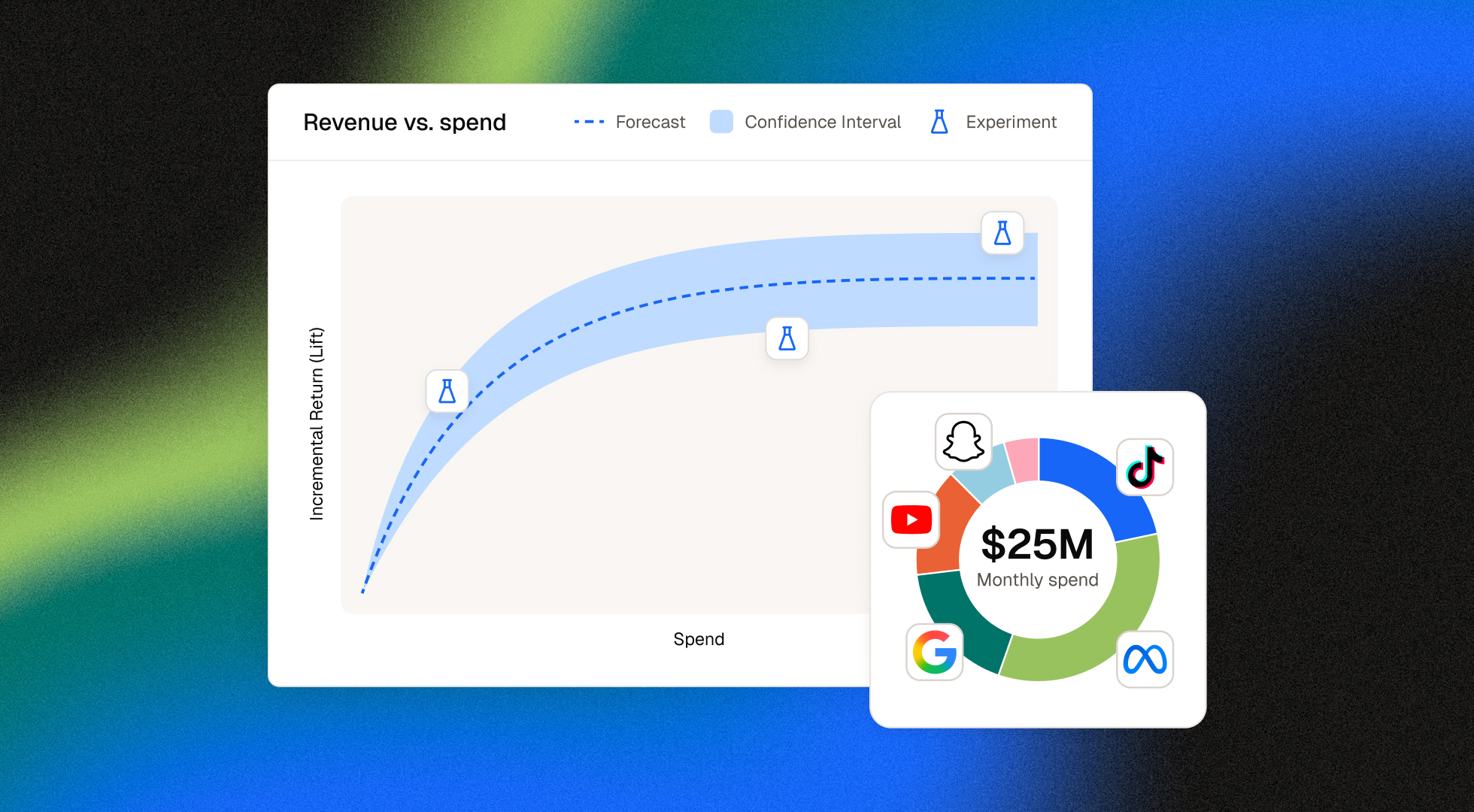
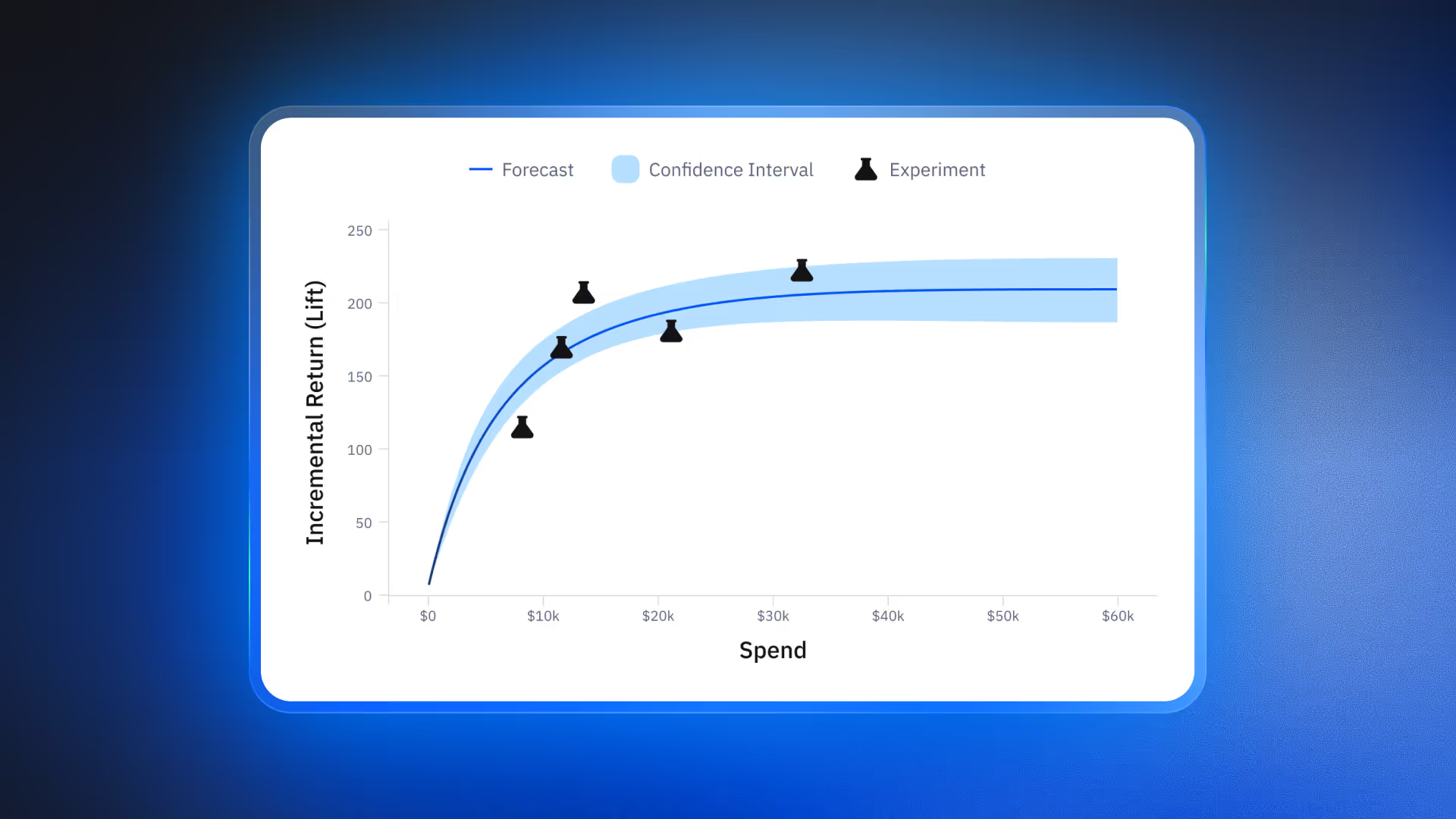
That makes Causal MMM especially useful for enterprise teams. You get the causal grounding of experimentation with the planning capabilities of MMM: a unified view of geo-segmentable and non-geo-segmentable channels, return curves that show where efficiency starts to decline, and scenario planning that helps answer “what if?” questions before you move budget. The model can also use its outputs to inform the next experiments, creating a loop in which testing improves the model and the model helps prioritize what to test next. See the cMMM Deck v2.
The tradeoff is that Causal MMM asks more of a team. You need a real experimentation program, clean channel definitions, reliable spend and outcome data, and scientific support to interpret uncertainty instead of treating every output as a fact. But for enterprise marketers making large, cross-channel allocation decisions, that is usually the point.
The goal is not to buy another black-box readout. It’s to build a measurement system that gets more useful every time you learn what actually works.
2. Open-Source MMM: Flexible, but resource-intensive at enterprise scale
Frameworks like Google’s Meridian, Meta’s Robyn, and PyMC give data scientists a starting point for MMM. You get a codebase you can customize and can benefit from improvements made by a broader technical community. For a smaller team with strong internal expertise and a relatively straightforward measurement question, that may be enough.
For a global enterprise, the framework is only the beginning. Open-source lowers the barrier to building an in-house MMM, but it does not eliminate the work of making that MMM useful. Your team still needs to integrate years of spend and business data. You also need to define channels in a way that aligns with how your business actually makes decisions.
Open-source is tempting because it can produce response curves in a matter of weeks. But getting outputs that stakeholders trust — and can act on — is a much bigger project.
There’s another important distinction: Open-source does not mean causal. Tools like Meridian and Robyn can incorporate experimental results to calibrate an MMM. But if the underlying model is still primarily built on historical data, those experiments may inform the model without anchoring its channel-contribution estimates.
See MMM Software: What Should You Look For? and Should I Build My Own MMM Software? for more on the tradeoffs.
The support gap matters, too. Open-source tools give you a codebase, documentation, and a community. They do not give you a measurement strategist who can help build an experimental roadmap and drive adoption. For teams that need the MMM to become an operating system for marketing decisions, open-source may not be robust enough on its own.
Best for: Small teams that value transparency and flexibility, have internal talent to maintain the MMM, and are comfortable with a directional model that requires ongoing validation. It is a poor fit for teams that need rigorous causal grounding, dedicated scientific support, fast iteration, and consequential budget decisions.
Examples of open-source MMM: Google’s Meridian, Meta’s Robyn, and PyMC
3. Consultant-Led MMM: Bespoke support at a high cost
Providers such as Analytic Partners, Kantar, TransUnion, Nielsen, and Ipsos have built businesses around bespoke econometric models, dedicated analyst teams, and high-touch relationships with complex global organizations. The appeal is obvious: You get people to wrangle the data, make judgment calls, explain the output, and adapt the model to the organization.
The tradeoff is that you are often paying for people because the process requires them. When every update depends on analyst review, each refresh can become a bottleneck. If an update takes several days, that may be too slow when you need to shift budget before a launch window closes.
This high-touch process is also expensive. You are buying dedicated analyst hours and a manual refresh process, not a self-serve tool that updates when your business needs an answer.
Crucially, consultant-led providers do not automatically solve the underlying problem with traditional MMM: Historical data is still correlational. If experiments are treated as suggestions rather than ground truth, you can still end up debating whose numbers are right instead of deciding what to do next.
Best for: Teams that can operate with an annual or quarterly strategic read and value bespoke analysis and consulting support. For teams making weekly budget decisions, the speed gap can be disqualifying.
Examples of consultant-led MMM: Analytic Partners, Kantar, Ipsos, Nielsen, and TransUnion
4. Test-Calibrated MMM: More grounded, but not the same as causal MMM
Controlled experiments are one of the strongest ways to estimate incremental impact. Newer platforms have emerged that use experiment results to calibrate their models. Measured, WorkMagic, and other entrants in the space describe their MMMs as “test-calibrated.”
The core limitation depends on how the calibration works. If experiment results are used only to inform priors in a model that still relies primarily on historical data, the experiments may not fully determine the channel-contribution estimates. Historical data can still carry too much weight.
A strong calibration approach should also account for experiment precision and spend level. Not all tests provide the same level of certainty, and not all tests represent the same investment level.
Causal MMM anchors channel contribution in experiment results. Haus’ posterior matching algorithm checks whether the fitted response curves agree with experiments at the spend levels tested. If there’s a conflict, the model updates and refits to account for experimental uncertainty. That’s what we mean when we say “anchor.”
Examples of test-calibrated MMM: WorkMagic and Measured
5. Traditional MMM: Broad context, limited causal confidence
Traditional MMM measures correlation, not causality. Its regression analysis can show that paid social spend and sales moved together, but it cannot prove that the spend caused the sales. Without a counterfactual — “what would have happened without the marketing?” — the model is still making an educated guess. If demand was already rising and the business increased spend in response, traditional MMM may give the media credit for growth it didn’t create.
That ambiguity gets worse when multiple channels move at the same time. A brand launches a promotion, increases paid social, adds TV, and sees revenue rise. Which input drove the result? Traditional MMMs have to untangle those signals from historical data, often using multiple years of observations. When the model cannot cleanly identify the cause, it can still produce precise-looking coefficients and ROI estimates.
Traditional MMM is also often too slow for enterprise teams. Models may be updated quarterly or annually, and they usually cannot provide granular insight into campaign, creative, or audience performance. By the time the output reaches the team, the market may have moved on.
Best for: Teams looking for broad, top-down strategic context. For most enterprise teams, that is not sufficient. You are investing in a model that requires years of data, moves slowly, and cannot establish causality. Adding experiments later may help address that weakness, but a more durable path is to start with causal evidence and use MMM to extend that learning across the full mix.
Examples: Legacy regression-based models, internal MMMs, and consultant-led models that are not grounded in experiments
Which MMM is best for an enterprise business?
For enterprise teams, Causal MMM is the strongest option when the goal is to make defensible, cross-channel budget decisions. It combines experimental evidence with the scale and planning capabilities of MMM.
But even a well-grounded model is only useful if it is integrated into the way the team allocates budget, acts on recommendations, and learns from the result. Architect sits on top of Causal MMM, using experiments, return curves, confidence intervals, and business context to turn a broad allocation plan into a prioritized set of next actions.
It explains why each move is recommended, sizes the move based on confidence, works within the guardrails the marketer sets, and refreshes recommendations as new data arrives. After a move is made, it evaluates the impact and improves its recommendations weekly.
Today’s enterprises need a measurement system that gets them from causal evidence to a decision they can defend — and then helps them learn whether that decision worked. The result is a clear next move, a record of what happened, and a system that gets better with every experiment and shift in spend.
Frequently asked questions about enterprise MMM
What is the best MMM for enterprise businesses?
Haus' Causal MMM is the strongest fit for enterprise teams that need defensible budget recommendations across multiple channels. It uses incrementality experiments to ground the model and historical data to extend those findings across the broader media mix.
What is the difference between Causal MMM and traditional MMM?
Traditional MMM primarily learns from historical correlations. Causal MMM uses incrementality experiments as a foundation, then uses MMM to model the broader mix and support forecasting, scenario planning, and budget allocation.
Is open-source MMM enough for an enterprise business?
It can be, but only when the organization has the data science, experimentation, engineering, and measurement expertise to build, validate, maintain, and operationalize the model. The framework itself does not provide that operating system.
Can MMM replace incrementality testing?
MMM and incrementality testing answer different questions. Experiments provide evidence about causal impact in tested settings; MMM helps extend that learning across channels, markets, and budget scenarios that may be difficult to test individually.


.jpg)

.png)









.avif)
.avif)

.avif)
.avif)

.avif)
.avif)
.avif)


.avif)


.avif)


.avif)
.avif)
.avif)
.avif)
.png)
.png)
.avif)


.avif)
.avif)
.avif)
.avif)
.avif)
.avif)

.avif)

.avif)

.avif)

.avif)
.avif)
.avif)
.avif)
.avif)


.avif)
.avif)

.avif)
.avif)

.avif)
.avif)
.avif)

.avif)

.avif)
.avif)
.avif)
.avif)


.avif)


.avif)
.avif)



.avif)
.avif)
.avif)

.avif)
.avif)
.avif)
.avif)
.avif)
.avif)