How a Culture of Continuous Testing Helped Gainbridge Tune Its Media Mix
- Industry
- Financial Services
- Channels
- MetaBrand SearchNon-Brand Search
- Features used
- GeoLift
The challenge
When digital annuity platform Gainbridge first partnered with Haus, they were ready to elevate their measurement maturity and move beyond the miscues of attribution and last‑click reporting — methods they knew were obscuring the true business impact of their marketing.
The Gainbridge team came to the table with strong hypotheses:
- Brand search might not be incremental.
- Non‑brand search was doing a lot of heavy lifting — but they wondered whether there was room to improve its efficiency.
- Paid social looked to have room to grow, but the team needed proof before scaling investment meaningfully.
At the same time, Gainbridge’s investment in marketing was changing. Through early 2024, combined paid search and paid social budgets were modest. But as growth goals grew more ambitious, Gainbridge pushed spend aggressively in 2025, scaling up paid search 1,000%+ YoY while beginning to scale paid social from small test budgets to its highest levels yet by early 2026.
Gainbridge wasn’t looking for a blunt “shift everything from one platform to another” answer. They wanted to know, with causal evidence, where each dollar should go for incremental ROI as budgets grew.
The solution
Gainbridge partnered with Haus to build a continuous testing program that treated paid search and paid social as complementary parts of the same growth engine — not winners and losers.
Together, the teams designed a sequence of geo holdout tests to answer three core questions:
- Is brand search incremental?
- What’s the most efficient way to scale non‑brand search at higher spend levels?
- Where does paid social make the most sense as the next slice of spend?
Each test used Haus’ GeoLift methodology, with clearly defined holdouts, time frames, and KPIs focused on applications signed — not just clicks or in‑platform conversions.
The result was a nuanced view of where paid search is indispensable, where it can be optimized as spend scales, and how paid social can play a growing, complementary role in driving the business.
Test 1: Finding savings in brand search
Gainbridge started with the channel they suspected was the least incremental: paid brand search. They implemented a substantial 50% holdout for three weeks to ensure exceptionally strong statistical power.
The result was clear: There was effectively no lift between exposed and control regions.
Test 2: Proving Meta’s role as the next slice of spend
With brand search learnings in hand, the natural question was: What next? They were confident they had room to grow on Meta, but they wanted to test that hypothesis with an incrementality experiment.
Meta Lift Test: Efficient, Incremental Growth at Test Scale
In the first Meta experiment, Gainbridge ran a three‑week geo test at a moderate spend level. The test showed Meta delivered:
- ~6% incremental lift in applications signed.
- CPIA significantly below their target efficiency.
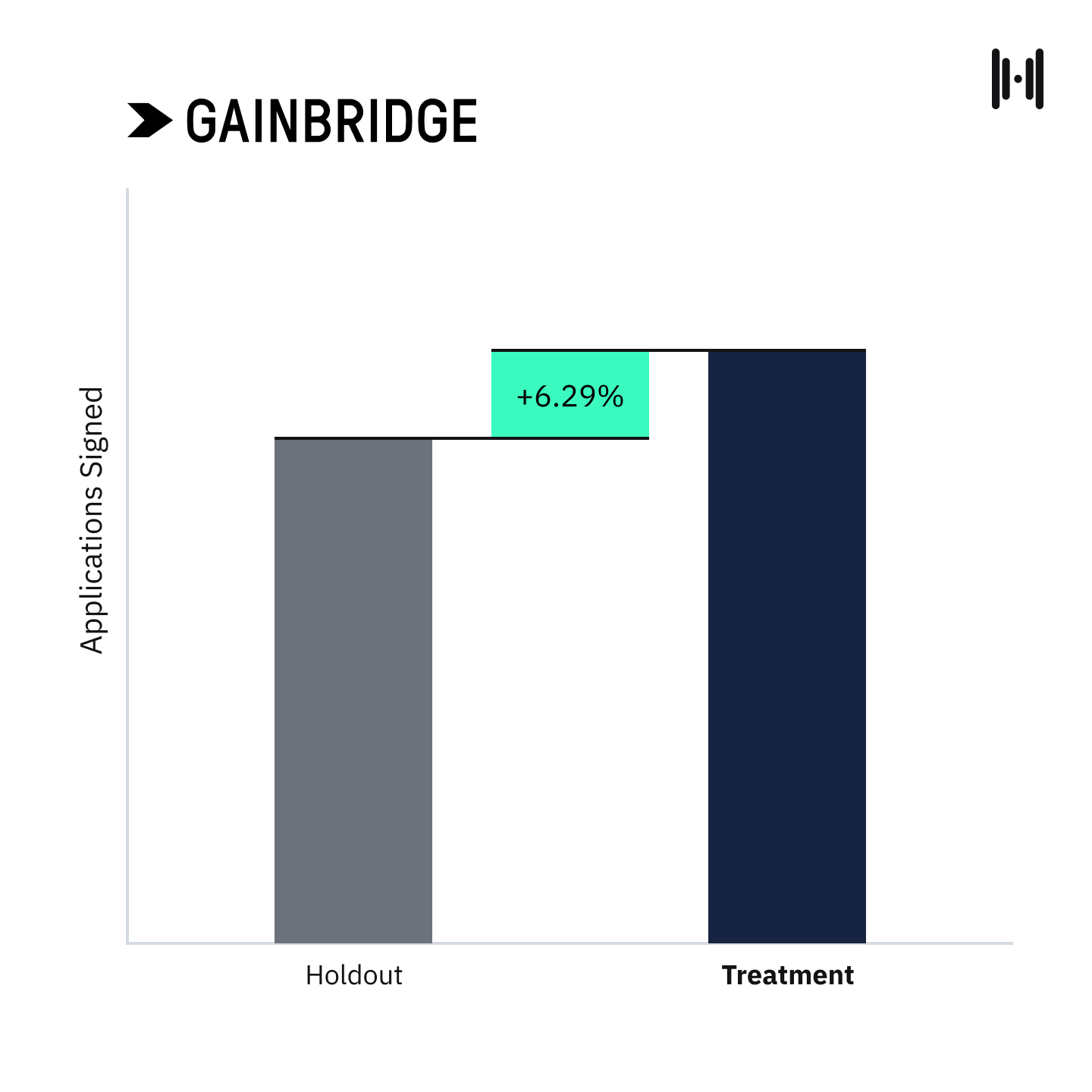
At this scale, Meta was a clear, data‑backed win — a channel that could convert some of the freed‑up brand search dollars into incremental growth at attractive economics.
Test 3: Optimizing high‑spend non‑brand search
Paid social had earned a bigger seat at the table. But the largest line item was still paid non‑brand search. To understand paid non-brand search’s impact on their business, they set up the following test:
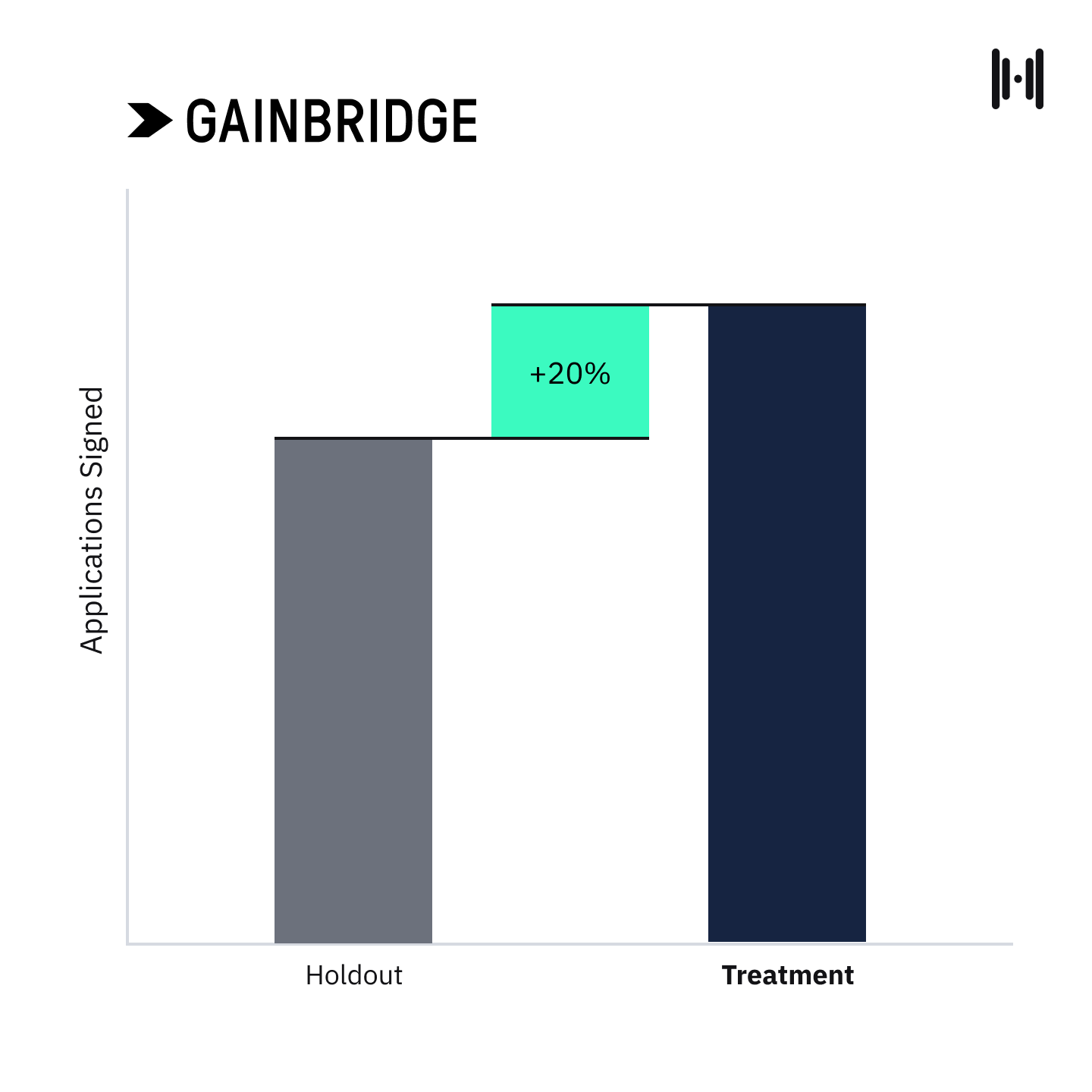
At this scale, non‑brand was the core engine of incremental growth:
- ~20% incremental lift in apps signed.
- Strong iROAS on Total Premiums, suggesting non-brand search played an important role in driving high-value customers.
But, after a 10x increase in paid search spend, CPIA was 2.3x above year-end target goal, indicating room to improve efficiency at higher spend levels.
In an effort to tighten efficiency while maintaining lift, Gainbridge and Haus together designed two additional tests to optimize non-brand search keywords.
Tests 4 and 5: Optimizing CDs vs. annuities in non‑brand search
These two tests split non-brand search into CDs vs. Annuities keyword clusters to explore Gainbridge’s hypothesis that CDs-based keywords were more valuable.
Both keyword cluster tests ultimately challenged Gainbridge’s original hypothesis that simply splitting spend across product-specific keyword groups would stretch the same budget further.
Instead, the results revealed that annuity keywords were more valuable to the business than initially expected and represented the clearest opportunity for continued scaling, while CD keywords — an area of strong internal interest — would require more targeted optimization to justify additional investment.
With policy-level results still incoming, early signals point to further room to optimize within paid non-brand search engine while continuing to drive growth.
The result
Instead of a “this platform works; this platform doesn’t” verdict, Gainbridge and Haus built something more powerful: A continuous optimization loop grounded in causal evidence.
- Step 1 – Remove non‑incremental spend:
Brand search tests gave Gainbridge the confidence to adjust a major line item with no observable loss in performance, unlocking significant savings.
- Step 2 – Reinvest in proven growth:
Meta lift tests showed where incremental growth was both real and efficient, turning it into a complementary growth driver to paid search.
- Step 3 – Tune the core engine:
High‑spend non‑brand search tests quantified both its incremental impact and efficiency tradeoffs that emerged at higher spend levels, creating a roadmap for ongoing optimization tests on bids, structure, and spend levels — rather than blanket cuts.
Today, Gainbridge’s media mix reflects what causal data actually says:
- Paid search remains the foundational driver of incremental growth, especially through non-brand search.
- Meta has been validated as an effective complementary channel for incremental growth.
- Brand search is a strong example of how causal evidence can challenge long-held assumptions and improve allocation decisions.
Gainbridge built a durable, continuous optimization program that continually rebalances paid search and paid social based on what’s incremental — month after month, test after test. Next step: Testing other demand-driving channels, such as CTV and YouTube, to understand where they fit in their mix.
Next steps
About Gainbridge
Gainbridge Insurance Agency, LLC (“Gainbridge”) was founded in 2018 as part of Group 1001 with a simple belief: people work hard for their money, and their money should work hard for them. We offer a simple, safe way to save for the future – with clear products, no hidden fees, and support from licensed experts whenever you need it. Gainbridge is headquartered in Zionsville, Indiana. Learn more at or connect with us on LinkedIn, Instagram, and X.
Published: July 21, 2026